

How to Set Boundaries in Relationships Without Feeling Guilty
If someone asked your friends, partner, parents, or colleagues to describe you, there’d probably be a bunch of positive words – the reliable one, the helpful one, always there for everybody. Pretty flattering, sure. But over time, doesn’t it start feeling a little…exhausting?


When people see you as someone they can lean on, they usually do. And the more it happens, the harder it is for you to start setting boundaries because you find yourself feeling guilty even thinking about it. Saying no doesn’t even seem like an option – disappointing someone who relies on you seems way more frightening than overstretching yourself.
But in reality, setting emotional boundaries is not a way to push people away or suddenly become a bad person. By learning to do so, you simply stop losing yourself in the process of being there for everyone else but you.
Why You Feel So Guilty About Saying No
Setting boundaries in a relationship, whether romantic or platonic, often means refusing to do something you can’t, or simply don’t want to, do. But while for some people it is completely natural, others often struggle to find the strength and end up agreeing to things regardless of their own feelings. Why? There are plenty of reasons, and they can be less obvious than you think.
Subjugation schema
For many people, setting boundaries without guilt feels impossible because the root of this inability comes from childhood conditions. In psychology, it’s called a subjugation schema – a deep internal belief that to avoid anger, rejection, or even abandonment, you need to completely surrender your preferences.
During your early years, you’ve probably learned that your needs are secondary to those of your parents or caregivers. So now, despite being an adult, even setting healthy relationship boundaries feels more like breaking a fundamental rule of survival. And when you agree to something you don’t want to do, it’s more than just trying to be nice. By doing so, you unconsciously follow a script that says your value is tied to your compliance.
Anxious attachment
If you constantly worry about the stability of your connections, you may have an anxious attachment style. And if that’s the case, setting emotional boundaries in relationships seems like a constant threat to those connections.
For this reason, the core fear is abandonment and rejection, which leads to submitting and accepting things that don’t feel right for you, just for the sake of protecting the relationship.
FOMO
Sometimes, what you think is guilt can actually be a completely different feeling. Saying no can also feel like you’re missing your chance to be included, helpful, or even chosen. It is a real psychological pattern called FoMO – an anxious sense that other people are having rewarding experiences without you.
So you end up saying yes since it is safer than the discomfort of being left out or falling behind – even if you’re exhausted or don’t even want to go in the first place.
Over-empathy
Over-empathetic people don’t just understand someone’s feelings but actually carry them. Which leads to quick sensing of discomfort, urgent need to fix it right away, and ends up with you taking responsibility for emotions that are not yours to manage.
Over time, that can slide into empathy burnout or compassion fatigue – emotional exhaustion that shows up when you’re constantly absorbing other people’s stress.
And once you’re in that state, saying no feels extremely cruel, because you can feel how they might react. The irony is that over-empathy usually leads to the exact thing you’re trying to avoid: irritability, resentment, withdrawal.
Fear of disappointing others
When your whole life you are the reliable one for others, setting boundaries with family, friends, or significant others can feel like breaking character. You know that people have certain expectations towards you, and the idea of not living up to them scares you more than doing something you don’t want to do.
But the usual outcome of following the same pattern is not so nice. You prioritize maintaining your image of reliability over your actual mental health, which, in the long run, leads to resentment, exhaustion, and burnout.
Lack of confidence
Many people struggle to assert themselves because they lack the confidence to handle the potential conflict that might follow. You might imagine that understanding how to set boundaries in a relationship involves a fight, shouting, or awkward tension that you aren’t equipped to manage.
This conflict avoidance results in prioritizing peace in the room over peace in your mind, leading you to agree to things simply to escape the immediate discomfort of standing your ground.
The First Step is Knowing How to Set Personal Boundaries
Understanding how to set healthy boundaries is an essential skill for anyone; yet, you can’t do that effectively until you know what your boundaries are in the first place. And figuring it out is not as hard as it might seem – you just need to dedicate some time to self-reflection.
Some questions that might help you understand yourself better:
- Who or what consistently drains my energy? Analyze your week and try to notice if there are any specific actions, interactions, or tasks that make you feel exhausted or heavy afterward.
- Who or what helps me recharge? After pinpointing the troubles, try to balance it with the opposite – things, actions, or people who make you feel happier and more full of energy.
- Are there things that I’m doing only out of obligation? Try to remember some of your past commitments, and then see how many you agreed to out of your own will, and how many were accepted just so you can avoid feeling guilty.
- How much alone time do I need to function well? For many people, solitude is an important part of preventing exhaustion and burnout. Yet, the extent of alone time differs – and it’s up to you to find out whether you need a quiet half an hour after work, or the whole weekend to yourself.
- What topics or actions are totally off-limits for me?Define your deal-breakers, and stick to them. This could include anything from being spoken to disrespectfully to discussing your finances or being expected to answer work emails on weekends.
Answering those questions can help you make a solid first step towards learning how to set personal boundaries and understanding yourself better in general.
How to Say No Politely Without Overexplaining
When you finally find the courage to set your boundary and say no to doing something, you might fall into another trap – a need to justify your refusal. You might believe that if you give a good enough reason, another person won’t get mad and understand you, which, once again, will prevent you from facing a somewhat unpleasant interaction.
In reality, however, the only thing you’re doing by explaining yourself too much is giving more space for negotiation to the person you’re talking to.
Let’s say you need to skip brunch with a friend on Saturday, because you’ve planned a deep apartment cleaning on your day off. So, naturally, you try to explain that you have this thing to do, but in response, your friend just offers to postpone your initial plan. And in the end, you just accept the invitation, because you still have to learn how to say no without feeling guilty.
So what do you do instead? For starters, keep in mind these simple yet effective mechanics:
- Drop the apology. You’re not committing a crime by not being able to do something – so instead of saying you’re sorry, just say “Thank you for thinking about me.”
- Keep it short. Again, the urge to overexplain might be strong, but you have to be stronger – the more you say, the more it starts to sound negotiable.
- Use full-stop sentences. Avoid saying “I can’t, but…” if you don’t want the other person to actually explore that option.
- Offer an alternative only if you mean it. Otherwise, it just becomes a softer yes.
- Don’t repeat yourself. One of the main rules on how to say no and mean it is to set a clear boundary with your initial refusal. If someone keeps pushing, restate that boundary and move on without any new reasons.
Scripts You Can Use to Start Saying No Today
Now that the rules and mechanics are clear, you need some practical examples on how to set boundaries in real life. So here are some scripts you can use in different contexts.
- I can’t this time, but thank you for asking.
- I’m not available, so I’ll have to pass.
- Unfortunately, that doesn’t work for me, but I hope it goes well.
- I’ve got too much on my plate right now, so I’ll pass this time.
- Thanks for offering, but I’ll have to sit this one out.
And if you face someone who keeps pushing, you can go with a bit stricter ones:
- I’m not able to do that, please don’t ask me again.
- I’ve answered already, and it’s still no.
- I’m not going to explain further.
- Please stop trying to negotiate this.
Setting Emotional Boundaries in Relationships
Romantic relationships are arguably the trickiest when it comes to personal boundaries, because a partner, especially a long-term one, is a person you share your space, routines, plans, stress, and life with. Yet, there is a very thin line between supporting your partner during hard times and actually carrying their emotional load by yourself.
One of the most important pieces of relationship advice is incredibly simple – you can be a loving partner without turning into an emotional sponge. Which means that you can be present, listen, and take care of your significant other, but you shouldn’t make it your responsibility to fix their mood or state.
Is there a way to tell that some overstepping is happening in your relationship? Absolutely. Pay attention to these signs:
- you feel responsible for always cheering up your partner
- you avoid difficult topics and conversations because you don’t want to trigger a reaction
- you drop your needs because your partner’s ones feel more urgent
- you end up doing emotional problem-solving even when you weren’t asked to do so
- you feel drained after helping, no matter how much you love your partner
If that sounds familiar, it doesn’t mean you need to immediately break up – there are many ways to fix those issues, especially when both partners are ready to do that.
Relationship Advice for Couples Dealing with Boundary Issues
The golden rule of boundary talk or any other difficult topic you need to discuss is to never bring up the issues mid-argument, during the fight, or when one or both partners are already dealing with a ton of other things. When things are calm, it’s easier to be heard, hence understood.
Even if you feel like you’re totally in the right and your partner is wrong, remember that the two of you are not fighting against each other but together against the issue. So don’t blame or attack – stay considerate, even when the things you need to say are not pleasant.
A few tips that make these conversations go more easily:
- Use “I” statements. If you want to be heard, make sure your words don’t sound like direct accusations (this way, your partner will focus on defending themselves instead of actually listening to you). Instead of saying “You always…” or “You never…” start with your own feelings. “I feel overwhelmed when we’re having guests every weekend” will definitely have a better response than “You’re always inviting people over.”
- The compliment sandwich. If you are nervous, wrap the boundary in reassurance. Start with affirmation , state the boundary, and end with connection. This reinforces that the boundary is for the relationship, not against it.
- Listen to their boundaries too. Healthy relationship boundaries are a two-way street. After you share yours, ask: "Is there anything you need from me to feel more supported?" This creates a dynamic of mutual respect, transforming the conversation from a list of demands into a collaborative effort to build a better life together.
A Note on Relationship Advice for Men
Being a man in the relationship often comes with a default expectation to fix things – both physical and emotional. And while it’s totally normal to do so if you actually feel like it, it is important to make sure you’re not sacrificing your own needs and neglecting your state while doing so.
Always remember that your boundaries are just as important as your partner’s. Don’t hesitate to bring up the issues that are bothering you, and don’t rush to fix things you didn’t break – especially if you weren’t asked to do so. Stay considerate of both your and your partner’s feelings, and remember that communication is key to strong and healthy relationships.
How to Handle Setting Boundaries With Family
The hardest part about setting boundaries with family is that they always know how to push your buttons – because they are the ones who installed them. Unlike friendship, where you are the one who’s setting up the dynamics, family roles are usually assigned at birth. That’s why when you’re setting a boundary, you’re breaking a pattern that has often been going on for generations.
And that can often lead to pushback – when one piece of a puzzle suddenly stops fitting, it makes everyone uncomfortable, so naturally, they are trying to get things back to “normal.” It can play out in different ways – from your parents guilt-tripping you for not coming home for Christmas, to your siblings giving you silent treatment when you refuse to lend them money.
And that’s when you need to stay strong and steady. Those actions and words (or lack thereof) are not signs that you’re doing something wrong. It might be hard for your family to accept you choosing yourself at first. But the more you stick to your needs, and the more firm your boundaries are, the faster they will accept it – and the easier it will be to communicate in the future.
What to Do When Setting Boundaries With Parents
For many adults, setting boundaries with parents is the final frontier of growing up. When you learn how to do so, it is extremely freeing, but before that, it might be a bit challenging. Your parents may still see you as a child who needs guidance, while you are trying to operate as an autonomous adult. This friction creates a specific type of guilt – the feeling that you are being "disrespectful" simply by having a different opinion or schedule.
To navigate this, you must shift the dynamic from "permission-seeking" to "informative." You are no longer asking if you can do something; you are informing them of what you are doing. This subtle shift in language reclaims your power without needing a fight.
- When parents criticize your choices (career, parenting, partner), do not justify yourself or argue. Simply say, “I appreciate your concern, but I’ve got this handled. I’ll ask if I need help.”
- If they call every day and get upset when you don’t answer, establish a new cadence. “I can’t talk during the work week, but I’d love to catch up properly on Sunday mornings.”
- If conversations always turn to guilt-inducing topics (like when you’ll give them grandkids), set a hard limit. “Mom/Dad, I’ve told you I’m not discussing that. If you keep bringing it up, I’m going to have to hang up.”
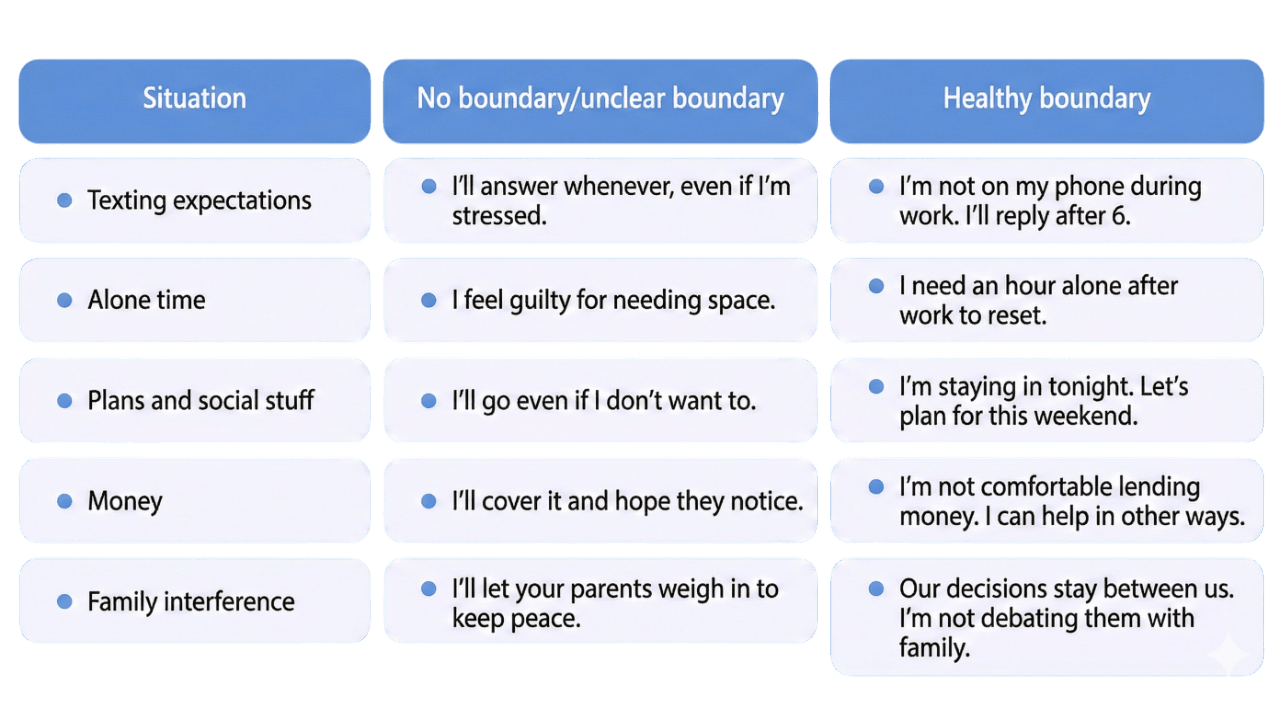
Real World Relationship Boundary Examples
Sometimes we let people cross our boundaries without even realizing that. Here are some common relationship boundary examples – and how to deal with them without sounding rude or feeling guilty.
Build a Better Life With Attainify
Reading about personal boundaries is a first step to actually learning how to set them. But sometimes, you need something more effective than general advice. Attainify turns it into a personalized action plan built specifically for your goals, triggers, and patterns.
You don’t need to guess the next step or read tons of literature to reach your goal. We’ll give you the quickest path – created specifically for you.
Don’t let guilt shape your future life. Get your personalized plan today.
FAQ
What is the first step in learning how to set healthy boundaries?
Self-reflection. You cannot effectively communicate your limits until you know what they are, so start by identifying exactly what drains your energy versus what recharges it.
Is it normal to feel guilty when setting boundaries in a relationship?
Yes. Guilt often shows up when you’re used to over-accommodating. It doesn’t mean you’re wrong; it means you’re changing a pattern.
How do I offer relationship advice to a partner who has no boundaries?
Bring it up when things are calm. Be specific, stay kind, and suggest one small boundary to try. You can support them, but you can’t do it for them.



Related Articles






Ready to Transform Your Life?
Take our 1-minute quiz and start your journey to self-discovery and personal growth today.
1-Minute Quiz