

Imposter Syndrome: How to Overcome It & Stop Undermining Success
Feeling like you don’t deserve your achievements can be deeply unsettling. That’s exactly what people with imposter syndrome experience regularly. Even when you’ve worked hard and delivered amazing results, a quiet voice inside insists it was “luck” or a “fluke.”


This experience is more common than most people realize. It affects staffers, students, and leaders across industries. In fact, the problem has nothing to do with your capability. It stems from persistent self-doubt that distorts your perception of success.
The first thing to do for healing is to understand this pattern. With the right strategies and tools, you can change the way you interpret your achievements, overcome imposter syndrome, and build a more grounded and confident mindset.
What Is Imposter Syndrome and How to Overcome It? (The Basics)
Imposter syndrome is a psychological pattern where capable and hard-working people struggle to accept their achievements. They don’t believe that their success is the result of skill and effort. They attribute it to luck, timing, or other external factors. This can lead to chronic worry about being “exposed,” even when performance is consistently strong.
How to overcome imposter syndrome? First of all, it is necessary to recognize an internal cycle:
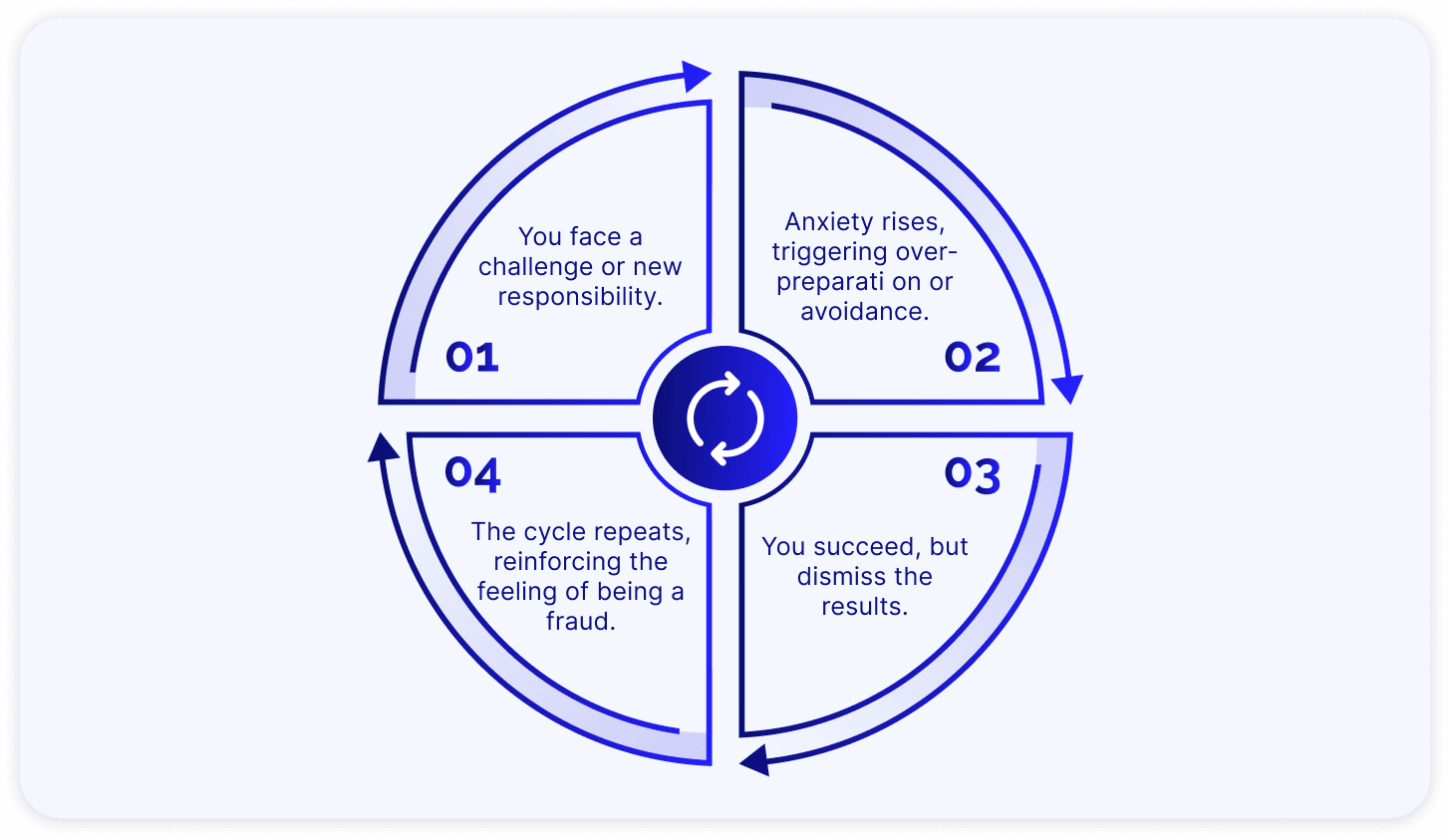
Typically, smart and capable people have imposter feelings. It drives crazy perfectionists, overthinkers, and individuals from groups who experience additional pressure to “prove themselves.” Studies show that up to 70% of people have experienced imposter syndrome at least once.
Researchers identify several types of imposter patterns: the Perfectionist, the Expert, the Soloist, the Natural Genius, and the Superhuman. Each has its own internal rules about what “counts” as success.
Fortunately, it is possible to treat and overcome imposter syndrome. The most popular approaches are cognitive reframing, self-compassion training, and exposure-based confidence building. Using different strategies and combining them, you will grasp how to overcome imposter syndrome at work and other settings in a sustainable way.
Dealing with Self-Doubt at Work: Why It Hits High Achievers
Eager beavers often appear confident on the outside but internally wrestle with intense performance pressure. This happens because success tends to raise expectations both from others and from yourself. The more you accomplish, the more you feel you “should” already know. That’s why dealing with self-doubt at work is especially challenging.
Work environments can intensify this pattern. When you face new roles, rapid promotions, unclear expectations, or work in a competitive team, you may be afraid of not measuring up. Even seasoned professionals can feel uneasy when they step outside their comfort zones.
Psychologists note that imposter thoughts are more common among ambitious individuals because they hold themselves to unrealistically high standards. When something feels unfamiliar or difficult, the brain mistakenly interprets it as evidence of incompetence. In reality, it’s simply part of the normal learning curve.
Recognizing this mismatch between perception and truth is the first step toward healthier self-belief.
How to Overcome Imposter Syndrome: 5 Evidence-Based Tips
Are you tired of feeling “not skillful enough” and ready to break the cycle? The good news is that most people don’t need a personality overhaul. The main thing is to find a new way of interacting with your thoughts, expectations, and achievements.
Cognitive restructuring, behavioral activation, and self-compassion exercises are the most popular methods among people trying to deal with imposter syndrome feelings. They help interrupt the fear-driven patterns that fuel self-doubt.
Before we present the five practical steps, remember that you don’t fix imposter syndrome by achieving more. First off, you need to reframe how you interpret your success.
The following techniques are grounded in psychology and can be applied at work, in relationships, and in other aspects of your life. Let’s explore them.
Tip 1: Separate Feelings from Facts (CBT)

People grappling with imposter syndrome and how to overcome it often choose CBT-based strategies. The core principle is to separate emotional reactions from observable reality. You may assume that you are not qualified enough, but your thoughts may not be truthful. When imposter thoughts show up, pause and ask: “Is there any evidence that supports this idea? What evidence contradicts it?” You’ll almost always find more proof of competence than failure.
This method helps interrupt the automatic cycle of overthinking and fear-based assumptions. When you clearly understand what thoughts are impostor ones, you can create psychological distance and have time to respond rationally rather than react out of panic. It’s a core principle in cognitive behavioral therapy and one of the most scientific solutions for imposter syndrome.
Still, you need to challenge cognitive errors, e.g., catastrophizing, consistently. Thus, you’ll retrain your brain to interpret challenges as growth opportunities, instead of threats. Over time, you will assess your achievements more objectively.
Tip 2: Document Your Wins (The Evidence Log)
When you struggle with self-worth, your brain tends to archive failures and forget successes. So, it is helpful to keep the “Evidence Log” to counter this bias. Thus, you will have a detailed record of your positive traits and achievements. You can create a digital folder, use an app on mobile, or turn to a good-old physical journal.
Make sure your evidence log includes:
- positive feedback
- successful projects
- client compliments
- promotions
- solved problems
- moments of courage.
Over time, your log becomes a factual counter-argument to any internal narrative telling you’re incompetent. This practice is especially useful for professionals grappling with self doubt at work. When doubt creeps in, review your log. It helps activate the rational part of the brain and helps ground you in truth. It’s a simple technique, but if you repeat it regularly, you’ll be able to make a lasting cognitive change.
Tip 3: Visualize Success (Not Just Avoidance)
It is typical of people with imposter tendencies to imagine worst-case scenarios rather than positive outcomes. This “catastrophic visualization” makes challenges seem bigger than they are. To break the cycle, it’s important to practice mental success instead of mental failure. Picture yourself speaking confidently or sharing your ideas while others are listening and nodding.
Visualization is a powerful psychological conditioning method. It is popular among athletes, executives, and other high performers. When you vividly imagine success, your brain encodes the scenario as familiar, so that you will feel less terrified when the real moment arrives. This technique is especially helpful for anyone exploring how to overcome imposter syndrome in a new job.
For best results, add sensory detail to your mental rehearsal:
- What do you hear?
- How is your posture?
- What can you see around you?
- What expression is on your face?
- What is the atmosphere of the room?
The more realistic the visualization, the more effectively it trains your nervous system for calm and confident action.
Tip 4: Talk It Out (Break the Silence)

Imposter syndrome thrives in silence. When you keep fears to yourself, they grow and become more convincing. Talking about your experience with trusted colleagues or friends can immediately reduce shame, because you’ll discover you are not alone. Many high achievers privately struggle with the same fears.
If you want to learn how to overcome imposter syndrome in relationships, open conversations are especially important. Sharing your insecurities with a partner can strengthen trust and reduce misunderstandings. Besides, you’ll be able to build a support system.
Therapists also use guided talk therapy to challenge distorted beliefs and increase self-awareness. By saying fears out loud, you’ll activate the brain’s language centers, and the emotional charge will reduce naturally. You don’t need to resolve everything in one conversation, but breaking the silence is an important first step.
Tip 5: Embrace "Good Enough"
Perfectionism is one of the strongest predictors of imposter syndrome. When you believe that every task must be flawless, everything can feel like failure. The antidote is practicing “good enough”. In other words, you should complete tasks to a high quality without chasing impossible standards.
By embracing imperfection, you can also reduce overwhelm and increase productivity. When you no longer fear mistakes, you become more willing to take risks, ask questions, and learn publicly. This is especially helpful for people learning how to overcome imposter syndrome at work.
“Good enough” doesn’t mean lowering your standards. It means recognizing that excellence is a spectrum, not an all-or-nothing outcome.
Beyond the Office: How to Overcome Imposter Syndrome in Relationships
Imposter feelings often spill into personal life, creating worries about disappointing a partner. To learn how to overcome imposter syndrome in relationships, you should establish a safe and emotionally stable environment. Next, do the following:
- Name the fear (“I’m afraid...”).
- Check assumptions before believing them.
- Share vulnerability to deepen the connection.
- Ask for clarity instead of mind-reading.
These habits reduce pressure and strengthen trust. You will feel valued for who you are, instead of trying to be perfect.
Stop Undermining Yourself: Build Confidence with Attainify
Attainify helps you interrupt self-doubt patterns and build confidence through behavior-based tools. You don’t need to rely on willpower alone. If you’re looking for how to overcome imposter syndrome tips, the app gives you daily momentum.
You can take advantage of AI Voice Coach, which challenges negative thoughts. There are also routine builders, visual timers, and step-by-step task planners. Soon, you’ll notice that such micro-shifts make imposter thoughts weaker and less convincing.
FAQ
How to overcome imposter syndrome at work quickly?
Start by interrupting negative thoughts and grounding yourself in facts. Write down the task, separate assumptions from evidence, and take one small step to build momentum. Say “This is a thought, not a truth” to lower anxiety. You can also use Attainify tools to get real-time support when stress spikes.
Is dealing with self-doubt at work a sign of incompetence?
Not. It usually reflects high self-awareness. Many top performers feel doubt when learning something new. Instead of viewing it as a failure, see it as a sign of growth. With practice, self-doubt becomes easier to manage and reduce.
How to overcome imposter syndrome in relationships?
Name the fears behind your insecurity and share them openly with your partner. Focus on facts instead of assumptions, and practice small moments of vulnerability. Thus, you can feel safer and reduce imposter-driven reactions over time.
Can Attainify help with dealing with self-doubt at work?
Yes, Attainify is a wonderful option for high achievers who feel overwhelmed or uncertain. You can take advantage of AI Voice Coach, motivation cues, and structured routines to replace negative thoughts with evidence-based confidence. Use the app regularly to improve self-perception at work.
Sources
- Prevalence, Predictors, and Treatment of Impostor Syndrome: a Systematic Review.
- Imposter Phenomenon.
- The Impostor Phenomenon: Toward a Better Understanding of the Nomological Network and Gender Differences.
- Cognitive Restructuring and Psychotherapy Outcome: A Meta-Analytic Review.
- A Narrative Review of Empirical Literature of Behavioral Activation Treatment for Depression.
- Self-Compassion Exercises.
- Cognitive Behavioural Therapy (CBT) Skills Workbook.
- The Efficacy of Cognitive Behavioral Therapy on Mental Health, Self-esteem and Emotion Regulation of Medical Students with Imposter Syndrome.
- Perfectionism, impostor phenomenon, and mental health in medicine: a literature review.



Related Articles






Ready to Transform Your Life?
Take our 1-minute quiz and start your journey to self-discovery and personal growth today.
1-Minute Quiz