

Overthinking: How to Quiet Your Mind and Regain Focus
Overthinking shows up as mental tension you carry through the day, or as a constant background loop you can’t fully turn off. A thought you can’t finish. A question you keep returning to. You tell yourself you’ll think about it later, but instead, your mind keeps circling, even when you’re tired, even when nothing new is happening.


This article is for anyone who feels mentally stuck, replaying conversations, analyzing relationships, or lying awake wondering how do I stop overthinking when the day is already over. Here, you’ll learn what actually helps stop overthinking, what mental clarity really looks like in real life, and how to calm your mind without forcing it to shut down.
What Is Mental Clarity? (Defining the Goal)
Before exploring how to stop overthinking, it’s important to understand the direction you’re moving toward. Many people imagine mental clarity as a completely quiet mind, but that’s not how the brain works.
So, what is mental clarity really?
From a psychological perspective, mental clarity refers to the ability to think without excessive mental noise, emotional overload, or constant self-interruption. Cognitive science research links clarity to better executive functioning, the brain’s ability to focus, prioritize, and shift attention when needed.
If you’re looking for a grounded mental clarity meaning, it includes:
- Being able to notice thoughts without immediately reacting to them
- Making decisions without endless second-guessing
- Feeling mentally present instead of scattered
- Experiencing thoughts as information, not threats
APA studies in neuroscience and psychology show that chronic rumination, a core feature of overthinking, keeps the brain’s stress systems activated.
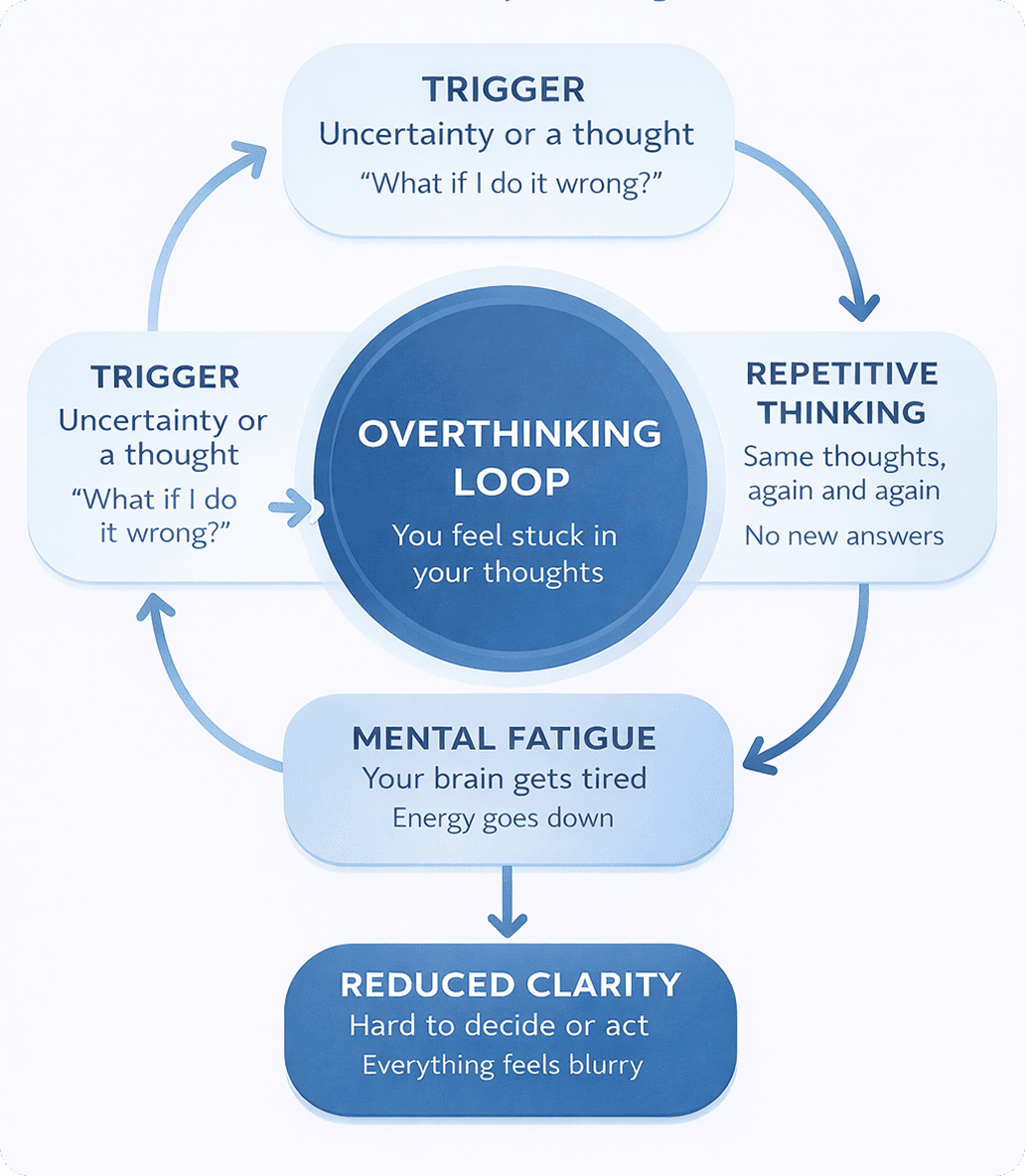
This pattern directly affects clarity mental health in daily life, often showing up as anxiety, fatigue, and reduced concentration. When the nervous system is calmer, emotional regulation improves and mental clarity becomes easier to access.
In simple terms, clarity doesn’t mean you stop thinking. It means thinking no longer controls you. And that’s exactly what the rest of this guide is designed to help you rebuild.
5 Ways to Stop Overthinking Everything & Improve Focus
Overthinking is usually a coping mechanism. It’s the mind trying to stay ahead, to prevent pain, mistakes, or uncertainty. The problem is that it doesn’t know when to stop. These approaches are not about forcing your mind to be quiet. They’re about helping it feel safe enough to slow down.
The Power of Journaling for Mental Clarity
If you’ve ever thought, “My head feels too full,” that’s exactly where journaling helps. The power of journaling for mental clarity comes from giving your thoughts somewhere to land instead of letting them circle endlessly.
Imagine the moment when your mind keeps replaying the same concern. You’re not solving it, just reliving it. Writing interrupts that loop. Once thoughts are on paper, they lose some of their urgency.
This is especially helpful if you’re asking how do you stop overthinking, because journaling doesn’t require insight or positivity. You simply write what’s there. Try this:
- Set a short timer (5–10 minutes).
- Write without rereading or correcting.
- Let the page hold the weight for you.
Grounding & Best Exercises for Mental Clarity
Overthinking usually pulls attention away from the present moment. Your body stays here, while your mind moves ahead, replaying conversations, predicting outcomes, or scanning for mistakes. In those moments, grounding is more helpful than trying to think your way out.
Many of the best exercises for mental clarity work through the body first. When breathing slows and attention returns to physical sensations, the nervous system begins to settle. As described by clinicians at Harvard Health Publishing, simple grounding techniques can reduce intrusive and repetitive thoughts by calming the body before engaging the mind.
Grounding can be very simple:- slowing the breath and letting the exhale lengthen
- feeling your feet on the floor or your body in the chair
- noticing one sound or sensation around you
These small actions help stop overthinking and naturally improve mental clarity, especially during stressful or overwhelming days.
Holistic Anchors: From Crystals to Breathing
Some people find comfort in having a physical or sensory anchor, something that helps them pause when their thoughts start to spiral. Practices like using crystals for mental clarity might work not because of belief, but because of association and intention.
Holding a stone, focusing on its texture, or pairing it with slow breathing can create a moment of stillness. That pause alone can be enough to interrupt a mental loop.
The same applies to short rituals: a morning breath practice, a calming scent, or a familiar object. These tools are particularly supportive if you struggle with how to stop being paranoid and overthinking, where the mind constantly scans for threat.
Holistic anchors don’t remove thoughts. They give you something steady to return to when your mind feels restless.
Cognitive Reframing (CBT)
Overthinking may sound convincing. Thoughts arrive with certainty, as if they’re stating facts, not possibilities. That’s why simply telling yourself to “stop” rarely works.
Cognitive reframing, a core CBT tool, helps create distance between you and your thoughts. If you’re wondering how do I stop overthinking, this shift is essential.
Instead of arguing with your mind, you gently question it:
- Is this thought a fact, or a fear-based interpretation?
- What evidence do I actually have?
- How would I speak to someone I care about in this situation?
This approach is powerful because it doesn’t invalidate your experience. Many people turn to it when they’re looking for how to stop negative overthinking, especially when thoughts feel convincing and hard to step away from.
The “Worry Time” Technique
This approach is especially helpful if you’re trying to figure out how to stop overthinking everything and notice that worries follow you throughout the day. When you try to push anxious thoughts away completely, they often return with more intensity. The “worry time” technique takes a different path by giving worry a clear boundary instead of letting it spread.
Mental health guidance from the UK’s public health service, NHS Every Mind Matters, describes structured worry time as a way to reduce repetitive thinking by containing it within a specific window. When worries have a place to go, they tend to feel less urgent during the rest of the day.
Here’s how the technique works:
- Choose a daily 15–20 minute window for worrying.
- Write down or think through concerns only during that time.
- When worries arise outside the window, gently note them and return to what you’re doing.
With repetition, the mind learns that worry doesn’t need constant attention. Thoughts lose intensity and become easier to step away from. This makes it one of the most practical ways to stop overthinking without criticism or force.
Nighttime Anxiety: How to Stop Overthinking at Night
You lie down, and suddenly one thought turns into five. A conversation from earlier replays. A decision you haven’t made yet starts to feel urgent. Questions that seemed manageable hours ago now feel heavier. If you’re wondering how to stop overthinking at night, this pattern may already feel familiar.
Sleep specialists writing for Harvard Health Publishing note that anxiety and repetitive thinking commonly interfere with sleep, especially when the brain hasn’t fully transitioned out of problem-solving mode. That’s why calming the body before bed helps more than trying to find answers in the dark.
In moments like this, gentle reassurance can help the body settle and signal that it’s safe to rest. Helpful practices look simple:
- slowing your breath and letting the exhale linger
- placing thoughts somewhere external, like a notebook beside the bed
- reminding yourself that nothing requires action right now
Nighttime anxiety eases not because thoughts disappear, but because the nervous system receives clearer signals of safety and rest. Small evening choices can either help the mind slow down or keep it alert longer than needed. This simple table offers soft guidance you can return to when nights feel restless.
Simple Nighttime Do’s & Don’ts for a Calmer Mind
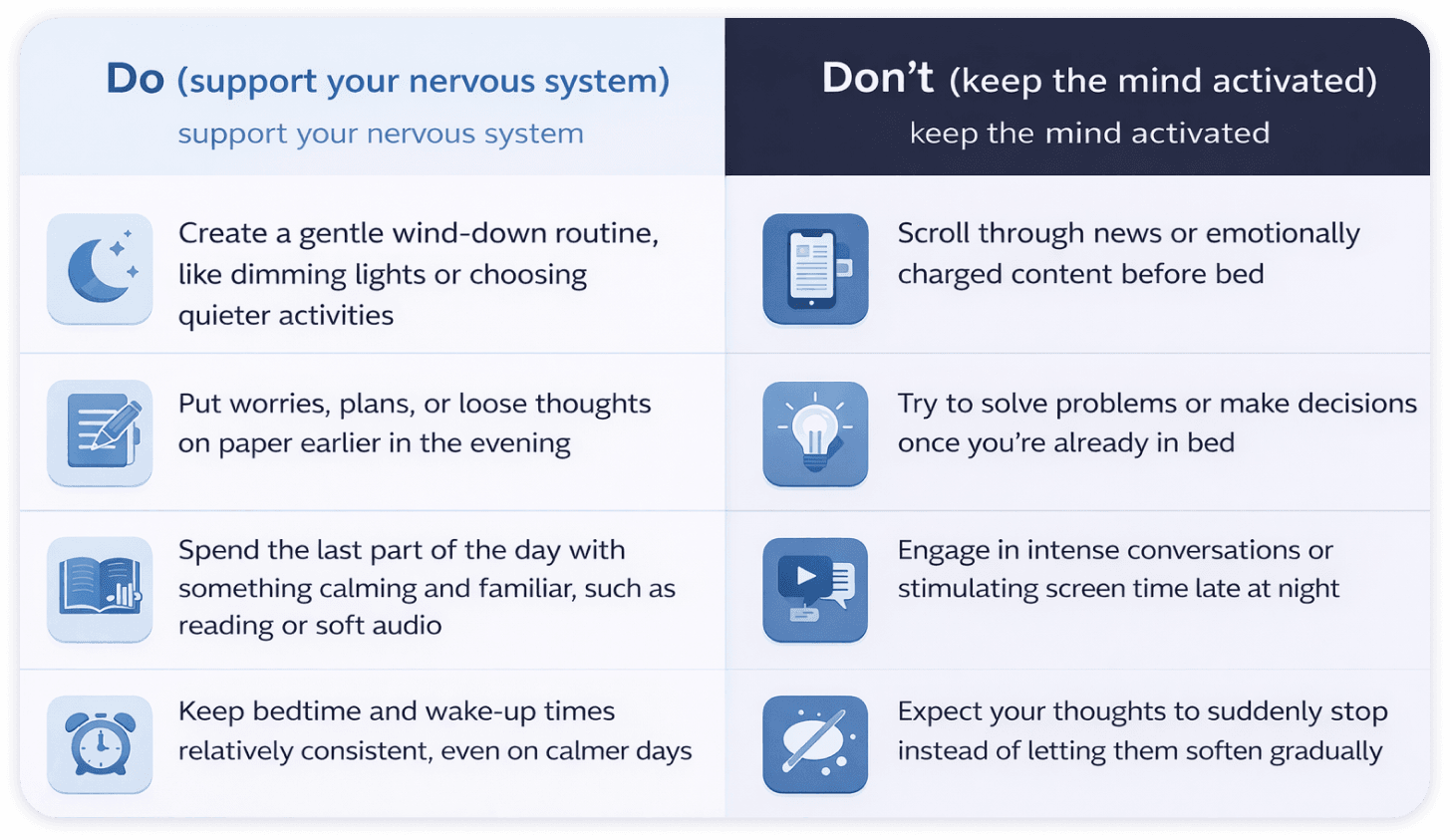
These habits can help evenings settle a little more easily. When nights feel calmer, mornings tend to feel clearer as well.
Relationships & Paranoia: How to Stop Spiraling
Overthinking shows up most strongly in relationships. A delayed message. A shorter reply than usual. A change in tone that might mean something or nothing at all. One small detail is enough for the mind to start filling in gaps. If you’re searching for how to stop overthinking in relationships, this familiar spiral is what you’re trying to quiet.
This pattern is sometimes called paranoia, but usually it’s a response to emotional uncertainty. When connection matters, the mind looks for clarity and reassurance. In close relationships, that can turn into how to stop being paranoid and overthinking, especially when trust feels fragile or easily shaken.
1. Separate what you noticed from what you concluded
Start with what you actually know.
“They replied later than usual” is something you observed.
“They’re pulling away” is a story your mind added.
2. Slow the moment before it escalates
Overthinking moves fast. Letting yourself pause, even briefly, can interrupt that momentum. You don’t need answers right away. You just need a little space.
3. Notice when reassurance starts to feel urgent
The urge to check, ask, or clarify can feel pressing. Pausing with that feeling for a moment can shift its intensity. What felt overwhelming can become easier to hold.
4. Gently ask what this moment is touching
Sometimes the reaction feels bigger than the situation. That’s a sign the past is involved. This question can be grounding if you’re trying to understand how to stop overthinking in a relationship after trust has felt uncertain.
5. Speak when staying silent keeps the spiral going
If grounding doesn’t help the thoughts settle, it may help to talk. Naming what you’re feeling (without blame or guessing) can ease tension and bring a sense of relief. This can be especially meaningful when you’re learning how to stop overthinking after being cheated on, where clarity grows through openness.
Overthinking in relationships shows how much connection matters to you. With patience and honest moments of communication, it’s possible to remain present without losing closeness or trust.
Regain Mental Clarity with Attainify
Mental clarity rarely appears because you force yourself to think differently, it grows when your mind feels supported enough to slow down. Even on calm days, thoughts can stay lightly active — revisiting, checking, circling. In those moments, clarity doesn’t come from effort. It comes from having something steady to lean on.
Attainify supports mental clarity by helping your situation feel more approachable. It gently breaks complex or overwhelming experiences into smaller parts, so your mind has something clear to work with. That sense of structure can make it easier to move forward without feeling pressured to change everything at once.
When the thought “how do I stop overthinking” shows up, it mostly comes with mental fatigue rather than urgency. What helps then is not another answer, but a clear next step. Attainify focuses on consistency over intensity, helping you work with simple practices and routines that unfold gradually.
With Attainify, that support includes:
- breaking overwhelming situations into small, realistic actions
- building a longer-term plan that develops over time
- using simple exercises that encourage calmer thinking
- creating a daily structure that supports focus and how to improve mental clarity
These tools are meant to be used gently and consistently. Small check-ins build familiarity. Familiarity creates a sense of safety. And safety is what allows the mind to settle and reorganize.
You don’t have to carry every thought on your own. Sometimes clarity grows simply because your mind knows what to do next.
FAQ
How do I stop overthinking instantly?
In moments when thoughts feel overwhelming, it helps to start with your body rather than your mind. Slow your breathing, feel where you’re sitting or standing, and let yourself pause for a few seconds. This doesn’t make thoughts disappear, but it reduces their intensity. Often, that small shift is enough to regain a sense of steadiness.
How to improve mental clarity naturally?
Mental clarity grows when your system feels supported. Regular rest, gentle movement, and moments of quiet all help your mind organize itself. Writing, breathing practices, and simple daily routines reduce mental noise over time. Clarity usually builds gradually, through consistency rather than effort.
Can crystals for mental clarity actually help?
For some people, crystals for mental clarity become a quiet reminder to slow down. You might keep one nearby, touch it when your thoughts start to scatter, and notice yourself taking a breath without planning it. The value is in that brief moment of stillness. When the mind has something steady to return to, it can feel a little less crowded.
How to stop overthinking everything all the time?
When overthinking feels constant, the mind is usually still carrying more than it can settle. Thoughts move on their own, even when you wish they would slow down. Bringing attention to something ordinary and present — the warmth of a cup, your breath, the weight of your body where you’re sitting can open a brief pause. Those pauses make it easier to stop overthinking and stay with what’s happening now.
How to stop overthinking in a relationship after trust issues?
After trust issues, thoughts linger longer than you expect. Conversations replay, small details stand out, and the mind stays alert. Slowing your responses, pausing before reacting, and grounding in the present moment can ease some of that mental strain. With steadier moments, mental clarity starts to feel closer.



Related Articles






Ready to Transform Your Life?
Take our 1-minute quiz and start your journey to self-discovery and personal growth today.
1-Minute Quiz