

Task Paralysis: Why You Can’t Start Even Simple Tasks (and How to Fix It)
If you frequently ask yourself why you feel stuck or unable to begin even the smallest tasks, you are not alone. What many describe as “laziness” is often not a personality flaw but a neurological bottleneck called task paralysis. It occurs when the brain’s executive system becomes overwhelmed, so starting to do something is next to impossible. For people with ADHD, burnout, anxiety, or constant stress, this state can become chronic. In this article, we’ll describe what task paralysis is, how executive dysfunction fits into the picture, and what can be done to fix the problem. Using evidence-based strategies and a neuro-affirming approach, we outline practical tools to help you regain clarity and emotional safety.


What Is Executive Dysfunction?
To understand task paralysis, you first need to grasp the executive dysfunction specifics. Executive functions are cognitive processes that help you plan, prioritize, initiate, and complete tasks. When these processes break down, the result is executive dysfunction, a state where starting or finishing tasks becomes disproportionately difficult compared to your intentions.
People experiencing executive dysfunction disorder often know exactly what they need to do, but cannot translate that intention into action. This condition is common in ADHD, anxiety, depression, autism, and periods of burnout. It is not a motivation problem. It is a neurological one. Understanding the executive dysfunction meaning helps eliminate shame and opens the door to realistic, compassionate solutions.
Executive Dysfunction Symptoms: Do You Have It?
Many individuals experiencing chronic overwhelm wonder whether they are dealing with executive dysfunction symptoms or just “procrastination.” The difference lies in how consistently the symptoms disrupt everyday functioning. Executive dysfunction affects task initiation, sequencing, time management, emotional regulation, and the ability to switch between tasks.
Here are common signs associated with ADHD executive dysfunction, burnout, and other neurocognitive conditions:
- Difficulty starting tasks, even if they are interesting to you;
- Overwhelm from tasks that consist of several processes;
- Feeling annoyed and paralyzed by choices;
- Frequent forgetfulness, misplacing items, or missing deadlines;
- Losing track of time, also known as time blindness;
- Inability to break large tasks into smaller, actionable ones;
- Emotional dysregulation or avoidance when stressed.
If these patterns sound familiar, you may be dealing with executive dysfunction disorder, especially if they persist across different environments, e.g., home, work, and school.
Recognizing the Core Executive Dysfunction Symptoms
Core executive dysfunction symptoms typically fall into three domains: task initiation, task management, and self-regulation. Individuals often describe feeling mentally “stuck,” as though their brain cannot transition from intention to action. This reflects a breakdown in internal cognitive sequencing.
Those with executive dysfunction ADHD may also struggle with working memory, when it is harder to track steps in a process. In executive dysfunction autism, sensory overload or transitions can further intensify the paralysis. The key insight is that these challenges arise from neurological processing and shouldn’t be perceived as personal failure. When assessed comprehensively, clinicians can often define executive dysfunction clearly and link it to treatable underlying causes.
Do I Have It? Executive Dysfunction Test & Self-Assessment
While there is no single universal executive dysfunction test, mental health professionals use validated tools such as the BRIEF-A, Barkley Deficits in Executive Functioning Scale, and ADHD assessments. However, self-assessment can provide initial clarity.

Ask yourself:
- Do I freeze when trying to start tasks, even simple ones?
- Do I experience task paralysis or lose hours to indecision?
- Does overwhelm lead me to avoid or shut down?
- Do deadlines force me to act only at the last minute?
- Do I struggle to estimate how long tasks will take?
If you answered “yes” to several items, you may be experiencing clinically relevant executive-function challenges. A formal evaluation can help determine next steps, including executive dysfunction treatment, therapy, or ADHD interventions.
The Connection: ADHD and Executive Dysfunction
The relationship between ADHD and executive dysfunction is direct and well-documented. ADHD is fundamentally a disorder of executive function, affecting prioritization, emotional regulation, working memory, and task initiation. This means ADHD task paralysis is not a motivational issue but a neurochemical one linked to dopamine regulation.
Research shows that people with ADHD often experience impaired activation networks in the brain, leading to delayed starts, overwhelm, and difficulty sustaining momentum. Understanding this connection helps individuals move away from self-blame and toward evidence-based management strategies.
So, if you struggle to start tasks, you are not “lazy”. Your brain needs more support, structure, and dopamine cues.
Task Paralysis vs. Executive Dysfunction: What’s the Difference?
While they overlap, task paralysis and executive dysfunction are not identical. Executive dysfunction is the broader neurological condition that affects planning, initiating, and following through on tasks. Task paralysis, on the other hand, is the state you enter when that dysfunction peaks, when you feel frozen and unable to begin.
Task paralysis often occurs when:
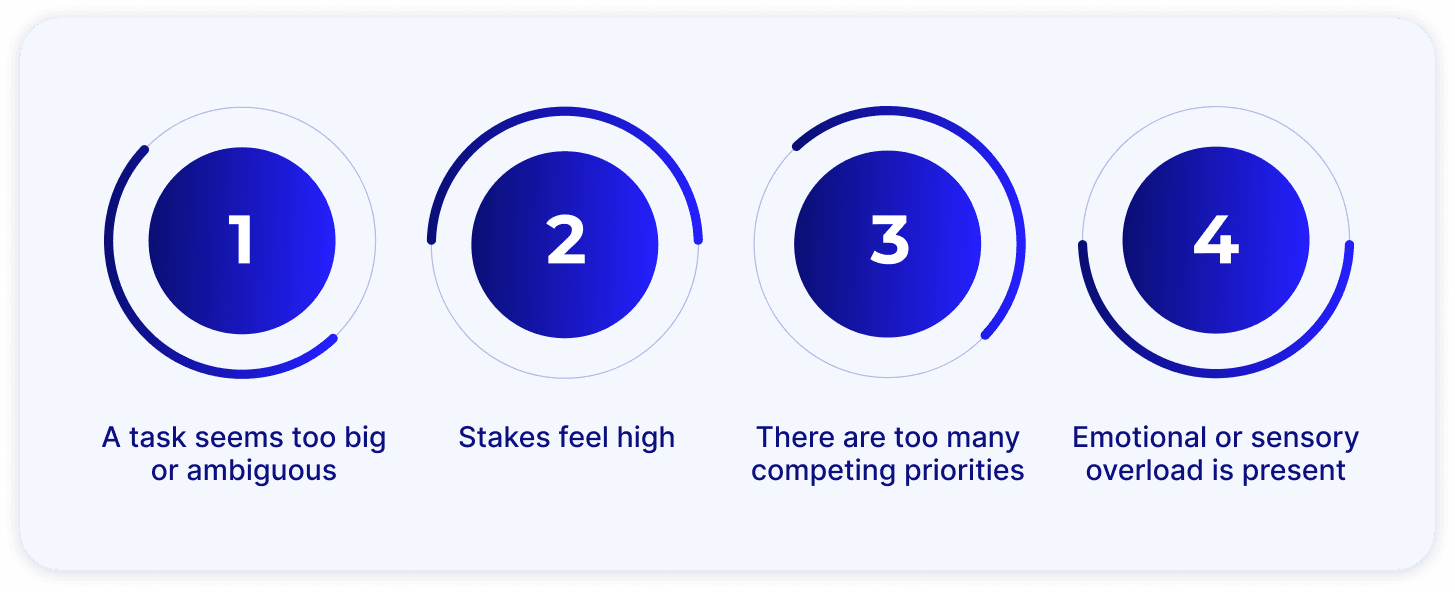
Understanding ADHD paralysis vs executive dysfunction is important because paralysis is a symptom, not the root cause. When you address underlying cognitive bottlenecks, namely, dopamine deficits, stress overload, and environmental friction, you have better chances to overcome paralysis itself.
How to Overcome Executive Dysfunction: 5 Actionable Strategies
If you are wondering how to fix executive dysfunction, the good news is that small, science-backed interventions can significantly reduce overwhelm. When used consistently, these strategies improve task initiation, reduce paralysis, and rebuild momentum.
Each suggestion below works especially well for task paralysis ADHD, burnout, and chronic stress conditions:
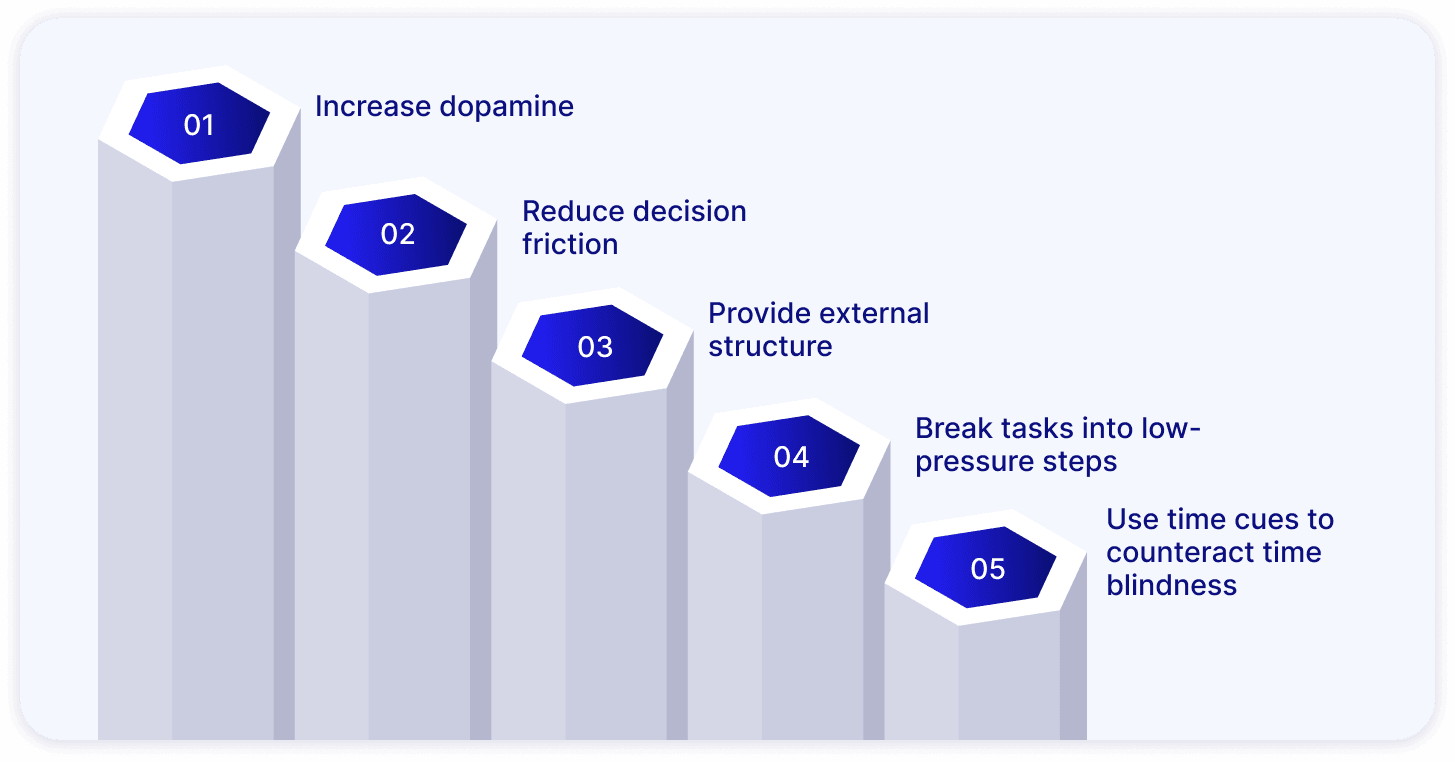
Below, you will find five practical tools to help you understand how to overcome executive dysfunction and start taking action again.
Strategy 1: Dopamine Menus & Gamification
For many people, especially those experiencing ADHD executive dysfunction, low dopamine is one of the biggest reasons why tasks feel impossible to start. When your brain does not produce enough dopamine during boring or complex tasks, you experience a form of neurological “stalling.”
A dopamine menu helps bridge that gap. It is a curated list of small, energizing, pleasure-based activities that reliably boost your dopamine levels. These can include short bursts of movement, music that stimulates focus or excitement, or sensory inputs.
Gamification builds on this by adding reward loops that make tasks feel engaging rather than draining. Together, dopamine menus and gamification shift your internal narrative from “I should do this” to “I want to do this.” By intentionally stimulating dopamine before task initiation, you break through the frozen state of executive dysfunction and provide your brain with the activation energy required to begin.
Strategy 2: Body Doubling (The Social Fix)
Body doubling is one of the most effective techniques for how to deal with executive dysfunction. This method involves working alongside another person, either in real life or virtually, to provide external structure, accountability, and co-regulation.
When someone else is present, your brain receives subtle cues to focus, start, and sustain effort. This lowers anxiety and reduces the cognitive load of self-regulating. People with ADHD task paralysis often find that body doubling immediately breaks the frozen state, allowing momentum to build naturally.
Strategy 3: The "Low-Stakes" Entry Point (Micro-Steps)

When a task feels overwhelming, your nervous system automatically shifts into a threat response. This can trigger avoidance, shutdown, or task paralysis, especially for individuals with ADHD or chronic stress. A low-stakes entry point interrupts this response by giving your brain a direction so small and non-threatening that it feels safe to begin. Instead of “clean the kitchen,” you choose “move one cup.” Instead of “write the report,” you choose “open the document and type one sentence.” The task does not change; only the activation threshold does.
Micro-steps work because they bypass the fear circuitry that typically drives task paralysis ADHD patterns. Large tasks require executive planning, prioritization, and emotional regulation. Micro-steps require almost none of those functions. They shrink the task to a size your brain believes it can handle.
Once the barrier to entry is lowered, momentum often follows naturally. Small progress produces dopamine, which further increases motivation and reduces the sense of threat. One tiny step leads to the next, and before you realize it, the task that felt impossible becomes manageable and even satisfying.
Strategy 4: Environment Design (Reducing Friction)
Environmental friction is one of the biggest predictors of executive dysfunction symptoms. Visual clutter, unclear task zones, or high-sensory environments drain cognitive resources and increase avoidance.
Reducing friction means adjusting your physical or digital environment to support easier starts:
- Create “single-purpose” spaces
- Remove visual distractions
- Keep essential tools within reach
- Use pre-set templates and automation
For individuals with executive dysfunction ADHD, or autism, environment design is a highly effective tool that reduces stress while increasing clarity and flow.
Strategy 5: Visual Timers & Time Boxing (Fighting Time Blindness)
Time blindness refers to an inability to sense the passage of time. It is a defining feature of executive dysfunction and ADHD. Visual timers anchor tasks in reality, giving you a clear start and end point.
Time boxing creates a protected container: “I will work for 10 minutes, then stop.” This reduces the emotional weight of starting and reframes tasks as temporary commitments rather than overwhelming obligations. The combination is especially effective for people facing ADHD paralysis and executive dysfunction, helping them shift from avoidance into action.
Stop Fighting Your Brain: Use Attainify as Your External CEO
When you experience task paralysis or executive dysfunction, your brain is missing the internal cues needed to start, structure, and complete tasks. Attainify acts as your “external CEO,” providing the guidance, sequencing, and emotional scaffolding that your executive system struggles to generate on its own. Instead of relying on sheer willpower, you outsource the cognitive load and let Attainify drive momentum.
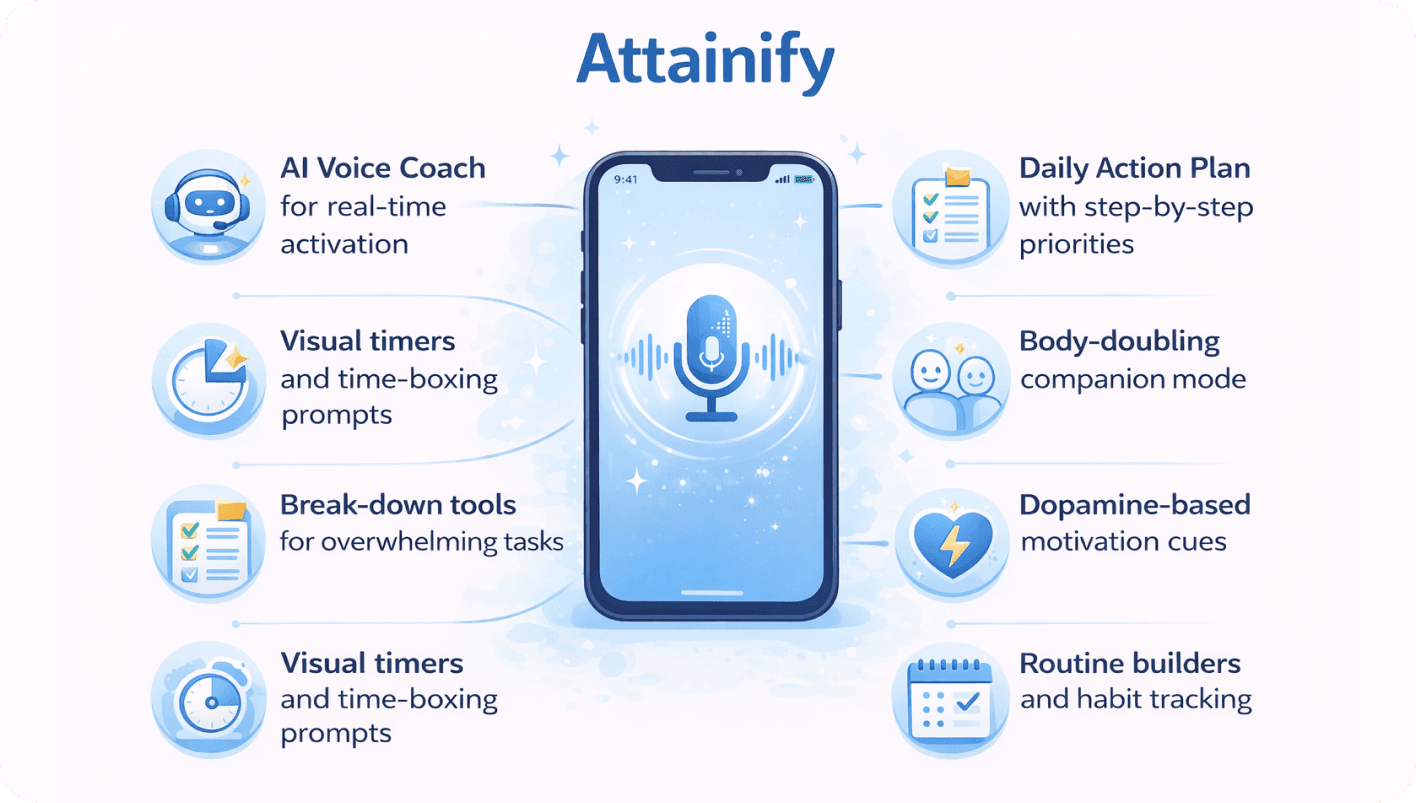
Attainify does not expect your brain to work differently. It provides the structure and dopamine incentives needed to overcome executive dysfunction sustainably.
FAQ
What is executive dysfunction in simple terms?
Executive dysfunction means your brain struggles to start tasks, stay organized, manage time, or shift between activities. It affects the “management system” of your mind – the part responsible for planning and follow-through. This is why people know what they need to do but cannot get themselves to begin. It is a neurological issue, not a character flaw, and it is especially common in ADHD, burnout, and chronic stress. When people clearly understand what executive dysfunction is, they have nothing to be ashamed of and can seek the right tools and support.
Is there a reliable executive dysfunction test?
There is no single universal executive dysfunction test, but clinicians use several validated tools that assess working memory, initiation, organization, and emotional regulation. The BRIEF-A and Barkley Deficits in Executive Functioning Scale are two of the most common assessments. ADHD diagnostic tools also help uncover associated executive dysfunction ADHD patterns. Self-assessments can offer clarity, but a licensed professional provides the most accurate interpretation. If symptoms disrupt daily life, a full evaluation can guide treatment options.
What is the main difference between ADHD paralysis vs executive dysfunction?
ADHD paralysis vs executive dysfunction comparison describes the difference between a symptom and a root cause. Executive dysfunction is the broader neurological condition that affects planning, initiation, time management, and emotional control. ADHD paralysis, or task paralysis ADHD, is the freeze state that occurs when those systems overload. In other words, executive dysfunction is the underlying mechanism, while task paralysis is what happens when the system becomes overwhelmed.
How to deal with executive dysfunction at work?
In this case, you should rely on structure rather than willpower. Break tasks into micro-steps, use external tools such as visual timers, and anchor your day with predictable routines. Reducing friction in your environment (clear workstations and pre-defined task lists) helps your brain transition more easily. Delegation, coworking, or body doubling can support accountability. If needed, accommodations or ADHD-related support can help reduce overwhelm and increase productivity.
How does the AI Voice Coach help break task paralysis?
Attainify’s AI Voice Coach combats task paralysis by offering real-time activation cues, emotional regulation support, and step-by-step guidance. It creates the structure your brain cannot generate on its own during overwhelming moments. The Coach prompts micro-actions, breaks down large tasks, and provides encouragement to counter avoidance. Its co-regulating presence mimics the benefits of body doubling, helping you initiate action faster. For individuals with ADHD and executive dysfunction, this external scaffolding can be transformative.
Does the "Daily Action Plan" help when I feel paralyzed by a large goal?
Yes. Attainify’s Daily Action Plan helps reduce overwhelm by sequencing your day into clear, manageable steps. When a goal seems too big, your brain struggles to prioritize, causing task paralysis. The Action Plan removes ambiguity by defining exactly what to do first, next, and last. It also keeps tasks low-stakes, making them easier to begin. This structured approach is especially valuable for those wondering how to overcome executive dysfunction in the context of long-term goals.
Sources
- Executive Functions: Definition, Contexts and Neuropsychological Profiles.
- Procrastination as evidence of executive functioning impairment in college students.
- Arousal dysregulation and executive dysfunction in attention deficit hyperactivity disorder (ADHD).
- The Relationship Between Executive Function Deficits and DSM-5-Defined ADHD Symptoms.
- Evaluating the Efficacy of Body Doubling for ADHD Using a Brain-Computer Interface.



Related Articles






Ready to Transform Your Life?
Take our 1-minute quiz and start your journey to self-discovery and personal growth today.
1-Minute Quiz