

How to Create a Personalized 30-Day Goal Plan
Most people start a new goal with a lot of energy and a rough plan. Day one feels different. You are energized and feel the gap between where you are and where you want to be. It feels realistic to close this gap for the first time in a while.


By week three, life has shifted, but the plan has not. Maybe your sleep has become worse, or your workload has increased. The version of you who made the plan and the version of you living inside week three are operating under completely different conditions.
So the next step is falling behind, accompanied by guilt because you have not followed through on the expectations that you set for yourself.
The problem is not your ambition but the structure you used to hold the goal.
Most goal-setting systems are built for your best conditions, which will not always correlate with reality. A plan designed for peak performance fails the moment performance dips, which means most plans fail people, not the other way around.
What works is a plan that adjusts to you, where falling behind in week two does not erase the progress made in week one.
The 30-60-90 day plan framework does this with a correct design.
What is a 30-60-90 Day Plan?
Understanding the 30 60 90 Rule for Career and Personal Goals
A 30/60/90 day plan breaks a large goal into three phases:
- days one through thirty for learning and orientation;
- days thirty-one through sixty for applying what you learned;
- days sixty-one through ninety for leading, producing, or consolidating.
The 30 60 90 rule works because the structure imposes short windows to stay focused, with enough total time for real change.
Setting clear, time-limited goals leads to better performance than having vague goals. The three-phase model replaces one far-off finish line with three that are easier to reach. [1]
Why Everyone Searches for a 30 60 90 Day Plan Template
People search for a template because they want to reduce the friction of starting. A template removes the blank-page problem. You fill in your goals, your metrics, and your milestones, and you begin.
The 30 60 90 day plan template can look like this:
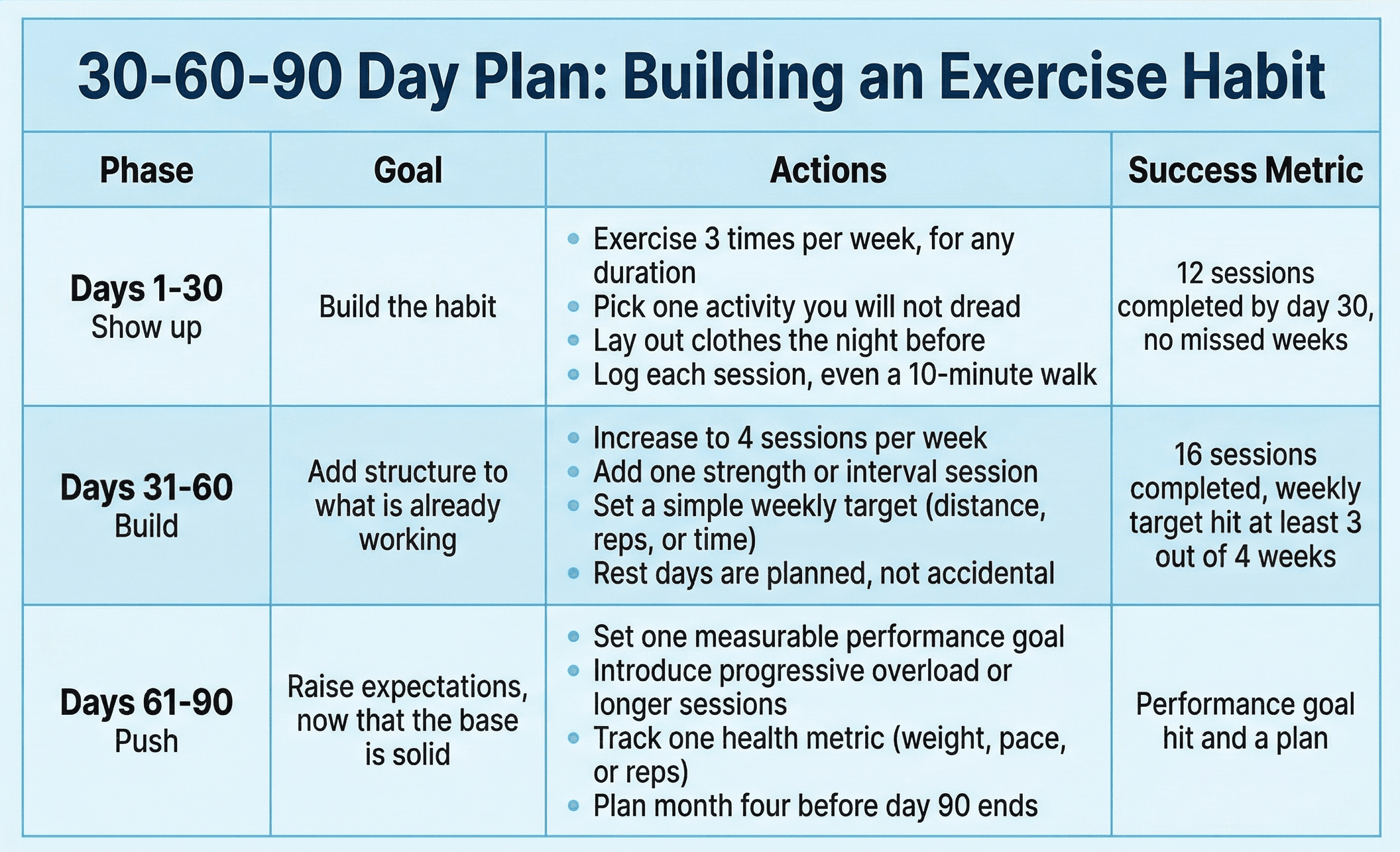
Setting specific goals helps you focus, figure out what's most important, and perform better at tasks.
The problem is what happens when things get real.
The Illusion of the Static 90 Day Plan Template
Why PDF Trackers and Rigid Spreadsheets Fail in the Real World
The thing is, any 30 60 90 plan template free version mostly looks the same with its columns, objectives, and checkboxes. The unspoken assumption is that the conditions on day one will stay the same until day ninety.
But they will not. Your energy goes up and down, and your priorities change. The spreadsheet does not know any of this. When you fall behind, the gap between your plan and your reality becomes demoralizing rather than informative.
This is why most 30 60 90 day plan users abandon their trackers before day forty-five. And it is not their personal failure, as the design just does not suit them.
The Danger of the "Perfect" 30/60/90 Plan Template Free Download
A 30 60 90 plan template creates the illusion of preparation.
It feels like progress to fill in boxes. But even when they have dealt with similar action plans before, people tend to underestimate how much time, work, and trouble await them.
While a static 90 day plan template does not account for this, an adaptive system will.
The Neuroscience of Goal Setting and Behavior Change
Synchronizing Your Motivation with a Cognitive Action Plan
Two findings from behavioral research explain why some 30-60-90 day plans work and most do not.
The first is implementation intentions. Tying a specific cue to a specific action, for example, "If it is 7 am on Monday, I open my goal review," improves goal attainment significantly.
A meta-analysis of 94 studies showed that this kind of if-then planning helps people stick to their plans. Each phase objective in your 30 60 90 plan works better with an if-then action attached.
The second is self-concordance. Goals aligned with your actual values persist longer and succeed more often.
A 30-60-90 day plan built around someone else's definition of success will fail before one built around yours. [2]
How a Detailed Roadmap Reduces Uncertainty and Saves Willpower
You decide to "eat healthy this week" but plan nothing specific. You open the fridge and face a string of small choices: what to cook, whether you have the ingredients, how long it will take, and whether it is worth it. By the time you finish deciding, you order takeout, and the cycle of unhealthy eating continues.
This is more common than you may imagine. Every decision draws from a finite daily reserve of cognitive energy. Those decisions exhaust your focus before you even begin to be productive.
With a detailed 30-60-90 day plan, you do not have to waste energy on choosing what to work on in the morning on Tuesday.
Even Jeff Bezos limits himself to a small number of high-quality decisions per day and structures his mornings to protect them. The logic behind a strong 30 60 90 day plan template is identical. [3]
But, even with all these benefits, will the plan be personal enough for you, particularly? Perhaps there is a way to customize a template like this just for you? We assure you, there is a way.
How to Create a Personalized 30-Day Goal Plan (The Attainify Approach)
1. Ditch the Generic 30 60 90 Template
A 30 60 90 template downloaded from the internet knows nothing about your energy level, your cognitive style, and your priorities. A generic template fills those gaps with assumptions, and the assumptions are usually wrong.
Attainify starts from a different premise: no plan should exist before understanding the person using it.
2. Take a Diagnostic Quiz to Gather Your Life Context
Before generating anything, Attainify questions – what are your actual priorities right now, not your aspirational ones? What is your current energy baseline? Where have previous attempts broken down?
Learning about people’s lives is a foundation for improving them. Perhaps you overloaded during the first two weeks and have no energy left in week three? With Attainify, the customized 30-60-90 day plan will take details like this into account.
3. Generate a Dynamic 30-Day Action Plan
A 2024 analysis of SMART goals confirmed that higher-quality, well-specified goals produce better follow-through. [4]
Attainify generates objectives with specific conditions, time windows, and measurable outputs attached.
The key difference from a static 30 60 90 day plan template: when conditions change, Attainify recalculates. If, by day eighteen, your check-in data shows you falling behind, the system rebuilds a plan within your current reach.
4. Recalculate Your Route with a Voice AI CoachWhen a week goes off plan, most people choose between pretending the deviation did not happen and abandoning the plan entirely. Attainify offers a third option.
The voice AI coach lets you describe what happened. The system responds with an adjusted 30-60-90 plan accounting for the new reality. The overall arc of growth stays intact, but the specific path adjusts.
Applying the Framework to Your Career: The First 90 Days of Employment
Why New Hires Need More Than a Basic 30-60-90 Day Onboarding Plan Template
The first 90 days of employment disproportionately shape long-term performance and retention. This window sets the trajectory for how a new hire is perceived, how quickly they become productive, and whether they stay past the first year. What happens in those ninety days establishes patterns, relationships, and reputations that persist for years, not just the first few months.
Most organizations treat onboarding as an information transfer problem. The new hire gets the tools, the logins, the org chart, and a few introductory meetings, and the rest is assumed to follow. But in reality, it rarely does.
Information transfer is only made to tell a new hire what already exists. It does not guide them on how decisions actually get made, which relationships carry the most influence, where the informal power sits, or what the team actually needs from them right now, versus what the job description said they would be doing.
A 30 60 90 day onboarding plan helps new hires structure this window intentionally instead of reacting to whatever comes up.
The plan creates a deliberate sequence: learn first, contribute second, lead third. Each phase builds on the previous one, and each phase has defined objectives, so the new hire knows what success looks like before the phase begins.
The First 30 Days: Focus on Learning, Not Just Doing
The first thirty days serve one function: understanding before acting. Map the team structure, the unwritten norms, and the relationships worth investing in early.
A 30 60 90 plan for new hires in this phase sets learning goals, not performance ones. The new hire who spends thirty days asking questions outperforms the one who spends those days appearing busy. [5]
Days 31-60: Transitioning from Observation to Action
By day thirty-one, you have enough context to contribute. The 30-60-90 day plan shifts from learning objectives to contribution objectives.
You begin owning your work and testing early hypotheses. Slowly, you identify where your skills create the clearest value.
Days 61-90: Taking Initiative and Showing Leadership
The last thirty days go from contribution to initiative. You suggest changes and take on work that was not assigned to you.
Spending the first sixty days in listening mode will improve your performance long-term and eventually get you to produce valuable output.
Tailoring the 30 60 90 Plan for Different Roles
Building a 30 60 90 Day Plan for Managers
Before changing anything, a new manager needs to understand what the team is actually doing, not just what the org chart says they are doing. This means one-on-one conversations with every direct report, reviewing recent project outcomes, and identifying where the team's energy is going versus where it should be going.
Through early relationship wins, trust builds. It can be removing a blocker the team has lived with for months or following through on something you said you would do. Small and reliable actions build the credibility needed to make phase three changes stick.
Structural improvements are introduced after sixty days of context. The changes land differently when the team has seen you listen first.
To sum up, 30 60 90 day plan for managers emphasizes:
team assessment in phase one;
early wins building trust in phase two;
structural improvements in phase three.
New managers who skip phase one and begin restructuring in week two damage relationships before they have built any.
Attainify builds a plan for managers around this exact sequence, so you never start phase two before phase one is genuinely complete.
30 60 90 Day New Hire Plan Template vs. Executive Strategy
New hires use the 30 60 90 day new hire plan template to orient to an existing system, while executives use the 30/60/90 plan to reshape one.
The structure is the same, but the content and stakes differ significantly.
A new hire who misreads the culture in phase one loses some credibility. An executive who misreads it in phase one and begins making structural changes can damage trust across an entire organization in ways that take years to repair.
The buffer of the three-phase model exists precisely to prevent this. Phase one is not passive. It is the most strategically important phase at the executive level, because every decision made in phases two and three will be filtered through the relationships and credibility built in phase one.
30-60-90 Day Plan Examples for Internal Promotions
Internal promotions are where static templates most visibly fail and where most people least expect to need a structured plan at all.
The reasoning is understandable. You already know the company and the people. You know the work. What is there to assess? Quite a lot, as it turns out.
Planning fallacy research shows that even experienced insiders underestimate the friction of new responsibilities. [5]
Picture: the team lead promoted to director discovers that overseeing managers is a different job than managing individual contributors. The senior engineer promoted to engineering manager finds the technical work has nearly disappeared, replaced by communication and performance conversations they were never trained for.
A 30-60-90 day plan for internal promotions needs explicit review points at days fifteen, thirty, and sixty to reassess whether original priorities match the reality of the role.
Attainify can assist internal transitions by creating a dynamic plan with review checkpoints and built-in self-correction.
Essential Elements of Any 30/60/90 Onboarding Plan
Defining Clear Metrics of Success
A 30 60 90 onboarding plan template without success metrics is a to-do list with dates. It tells you what to do but gives you no way to know whether you did it well.
That distinction matters because the absence of clear metrics makes motivation harder. When you cannot measure progress, you cannot feel progress, and without that feedback, the plan quickly loses its grip.
For each phase of your 30 60 90 review template, define one to three observable, time-bound metrics per objective. The test for a good metric is simple: could two different people look at the same evidence and agree on whether it was met?
"Build relationships with five key stakeholders by day thirty" is a metric, but "network effectively" is not, as it is too generalized and vague.
A few more practical examples:
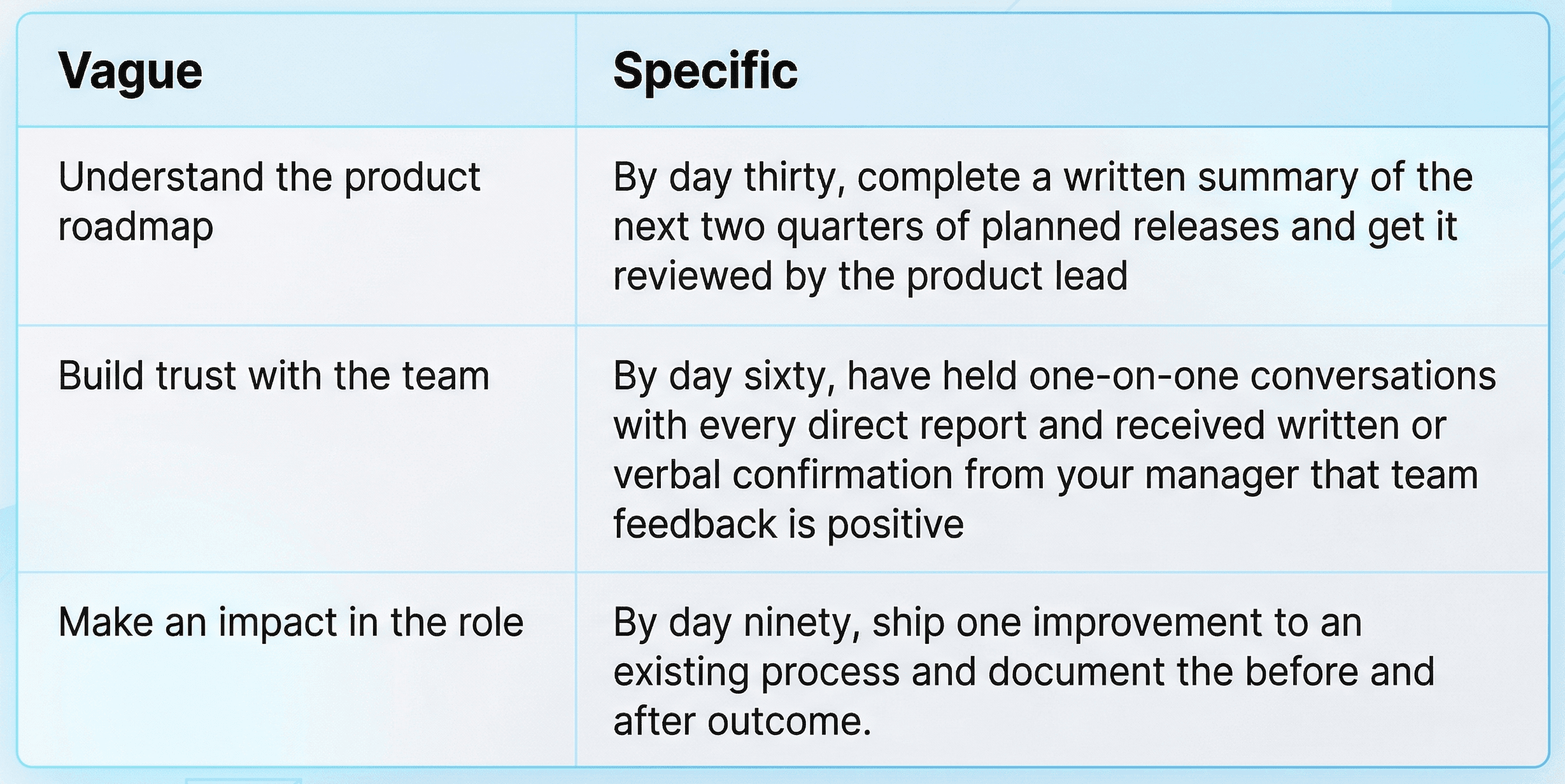
The specifics make the difference between a plan that guides your decisions daily and one that sits in a folder.
Scheduling 30 60 90 Review Template Check-Ins
For every 30 60 90 day onboarding plan, schedule a review at the end of each phase, which is best to be done as soon as possible to avoid unresolved problems.
Ask three questions:
- What was achieved?
- What did not go as expected?
- What changes are needed for the next phase?
Most people spend the entire review on question one and treat questions two and three as afterthoughts.
This is the wrong order of importance. What did not go as expected is the most useful data the plan produces.
There may be a project that took longer than planned, a relationship with a colleague that did not form the way you expected, or a priority that turned out to be lower stakes than it appeared on paper.
None of these is a failure. In fact, they can provide corrections to your model of the role, and they make your phase two and phase three plans more accurate than they would otherwise be.
Without these check-ins, a 30/60/90 onboarding plan becomes a document you file rather than a system you use. The plan you submitted on day one and the reality you are living on day forty-five will have diverged. The check-in is the mechanism for closing that gap before it widens into something harder to recover from.
With Attainify, you arrive with a structured sequence already in place rather than spending your first week figuring out where to begin.
Transitioning from Static to Dynamic Planning
Why a 30-60-90 Day Plan Template for New Employees Must Be Flexible
Adaptive pathways research shows plans under uncertainty are more durable when they include initial actions, longer-term options, and explicit triggers for change. Most templates make the mistake of only including actions.
The initial action is the easiest part: meet people by day fifteen, complete this training by day twenty, and submit this report by day thirty. New employees fill these in readily because they reflect what the role looks like from the outside before starting.
The longer-term option is what you do when the initial action does not go as planned. What if the training takes twice as long as expected, and the manager you needed to meet is on leave? Perhaps the project you were assigned gets deprioritized in week two?
The trigger is the condition that tells you when to stop following the original plan and switch to the adjusted one. Without a trigger, most people keep following the original plan past the point where it stopped making sense, because switching feels like admitting failure.
A 30-60-90 day plan template for new employees needs all three: the action, the contingency, and the condition telling you when to reassess. Without these, the 30 60 90 day onboarding template becomes a projection of how you wish your initialization would go. [6]
This is where Attainify steps in. It can create a plan with a dynamic flow that would assist the new employees, not confuse them further.
Embracing Imperfect Conditions to Reach Your Goals
Every 30-60-90 day plan is written under better conditions than the ones in which it will be executed. You craft the plan before the job starts, before you know your manager's real priorities, and discover which relationships are harder to build than expected.
But such a plan produces a specific failure mode: the person follows it until the first significant deviation, then loses confidence in both the plan and themselves, and either abandons the structure entirely or keeps following a plan that no longer reflects the actual job. Neither outcome serves them.
The shift from static to dynamic planning means treating deviation as data. When week two does not go as planned, the question is not "how do I get back on track?" It is: "what did week two reveal about the plan, and how does the plan change?"
In a dynamic plan, the deviation improves the next phase. Attainify sympathizes with the struggles and uses them to improve the plan long-term.
Summary: Stop Planning, Start Adapting
A 30 60 90 day plan works when the plan is specific, time-bound, and flexible enough to survive real conditions. Static templates give you the first two. Attainify gives you all three.
The 30-60-90 rule is not a format. The framework is a logic: short windows to stay focused, spaced far enough apart for real progress, with checkpoints for recalibration.
What breaks the logic is treating it as a fixed document rather than an operating system that takes in new information and adjusts its outputs accordingly.
Attainify applies this logic directly.
The diagnostic quiz builds the plan from your actual baseline, not an assumed one. The 30-day adaptation model adds complexity only as your engagement data supports it. The voice AI coach recalibrates when a week goes off course. As a result, you get an actual plan that can be finished.
Frequently Asked Questions (FAQ)
What is the best format for a 30 60 90 day template?
The best 30 60 90 template translates high-level objectives into steps that have clear success metrics per phase. Format matters less than specificity.
A well-designed 30 60 90 day plan template in a notes app outperforms a formatted PDF with vague objectives. Add if-then implementation intentions for each major task and a scheduled review at each phase end.
How do I write a 30 60 90 plan for new hires without overwhelming them?
Start with fewer objectives.
A 30 60 90 plan for new hires with three clear priorities per phase outperforms one with ten. Front-load the first thirty days with learning goals. Make sure that success metrics are easy to see, and set up a mid-phase check-in on day fifteen so that the new hire can ask questions before they get too confused.
Can I use a 30-60-90 onboarding plan template for personal fitness goals?
Yes. The 30-60-90 day onboarding plan template logic transfers directly.
- The first thirty days set the standard for how things should be done and how people should move.
- Days thirty-one to sixty add more volume or intensity based on what was learned in the first phase.
- Days sixty-one through ninety shift to performance or composition goals built on the foundation of the earlier phases.
Sources:
https://www.academia.edu/117538218/Goal_setting_theory
https://pubmed.ncbi.nlm.nih.gov/10101878/
https://qz.com/work/1390844/jeff-bezos-only-expects-himself-to-make-three-good-decisions-a-day
https://www.deepuncertainty.org/2020/10/14/adaptive-planning-and-adaptive-pathways/



Related Articles





Ready to Transform Your Life?
Take our 1-minute quiz and start your journey to self-discovery and personal growth today.
1-Minute Quiz