

Personalized Action Plans: Why Generic Productivity Advice Doesn't Work
Pre-made action plan templates, rigorous morning routines, and inspirational quotes are all over the internet, and they claim to help you accomplish more. But do these systems really do what they say they will? And most importantly, do they fit your life and situation?


A lot of people give up on these plans because they are too broad and don't relate to real life. This poses an important question: why do so many systems for getting things done not work?
The main reason is easy: most productivity systems don't take into account people's unique situations.
Real-life obligations and surprises are rarely taken into account. The workload and energy levels of the individual are not considered. In a world full of distractions, it's simple to deviate from rigid routines and then struggle to get started on anything.
Should action plans be flexible and customized to meet the needs of each individual instead of being set in stone? We think they should, and this is crucial.
In our article, we will dive deeper into the topic and also summarize the main steps an individual should take when developing an action plan. So, how do we create a personalized, inspiring schedule that will not put too much pressure on us?
The Toxic Hustle Culture: Why Generic Productivity Advice Doesn't Work
If you use social media a lot, you have probably seen variations of the same story: people waking up at 5 am, working hard, and following their routine. They present themselves as disciplined and productive. And, of course, you start feeling insecure and comparing yourself to others. Does this sound familiar?
In fact, this modern culture is only placing pressure on already overworked and stressed people.
Trying to strictly follow the same patterns every day with the effort to appear committed leads to serious burnout and damages self-confidence. According to Forbes, 66% of U.S. workers experience burnout, the highest among younger generations at 81-83%.
One thing to remember about productivity is that it assumes the person is in the best position to reach their goal. But life isn't that simple. There are always problems, whether they come from the way the world is right now or from some basic human thing like sickness.
The Problem with the Standard Plan of Action Template
The conventional action plan templates include:
- objectives;
- due dates;
- duties;
- achievements;
- milestones.
Ironically, a lot of action plans are ineffective because of this structure.
Real people aren't machines; they feel a certain way. One day you may have a lot of energy, and the next day you may be tired and sleepy. Therefore, you cannot be equally productive on both of these days. Cognitive paralysis, like anxiety and decision fatigue, can factor into that as well.
In real life, anything can happen that makes you feel bad and unfulfilled about your daily stats.
What is the Purpose of an Action Plan?
A structured roadmap that helps you reach certain goals is what most people think of when they hear the word "action plan."
But for this kind of plan to work better, it should function more like a set of guidelines that nudge the person to do what they need to do.
Its true purpose is to guide, not pressure.
Why There Isn't a Perfect Example of an Action Plan
People often look for perfect action plan templates when they feel like they are losing control of their lives.
One can download a lot of templates from the internet, both free and paid. Some are made by professionals and coaches who sell them on the internet. These action plan examples seem easy to use and adhere to, so it's easy to understand why they're so popular.
This is an action plan example with a strict routine.
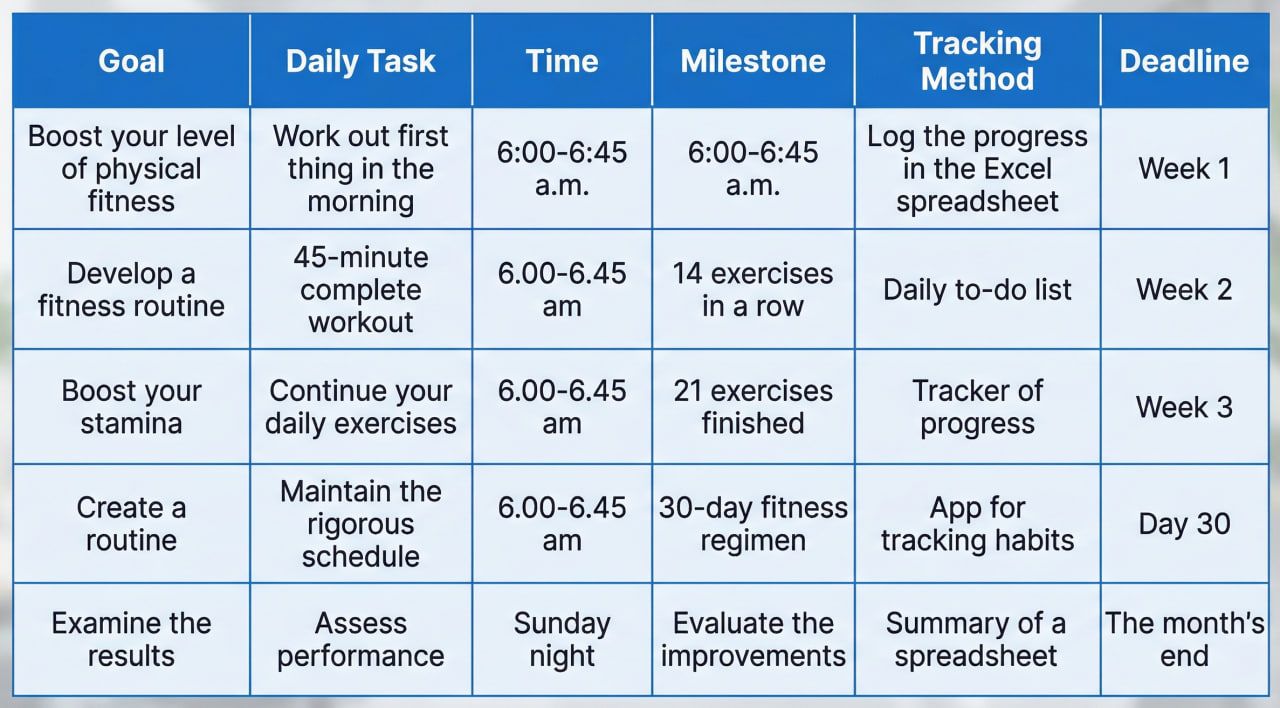
This action plan sample looks great on paper and seems like it would be helpful.
But templates like these still miss some important things, like the cognitive abilities of each person or how unexpected personal events can throw you off course.
People might stick with a plan of action example like this for a few days or weeks before giving up – because these types of schedules are more stressful than helpful.
Why Your Personal Action Plan Fails in Non-Ideal Conditions
Real life is not bound to a strict daily schedule. And getting too attached to a sample action plan template like the one above, trying to stick to its rigid routine, can be harmful. It can be interrupted by anything, and here are some examples:
- tiredness, illness, or burnout;
- injuries to the body;
- problems that come up out of the blue and need to be fixed right away, whether they are yours or someone else's;
- setbacks with the weather or transportation.
Even good surprises, like running into an old friend by chance or getting tickets to an event at the last minute, will make it harder to stick to a plan of action and make you feel like you're falling behind.
Rigid Action Plan with Strict Routine (The Outdated Way)
The old-fashioned action plan format assumes that everyone sticks to a strict schedule.
For instance, you could:
- get up every day at six in the morning;
- work out for forty-five minutes right away after waking up;
- stick to three meals a day;
- keep track of every change in an Excel file.
This is just one such template, with many more to be found all over the internet and social media. Some of these action steps examples may also have strict rules, like working out for 30 minutes every day for a month.
This looks like a solid plan. But it doesn't allow for emergencies or disruptions, and people feel like they've failed when they break the routine. This "failure" eventually means giving up on such rigid examples of action plans completely.
Simple distractions can often get in the way and mess up the whole routine. Gloria Mark, a psychologist, found that people only pay attention for an average of 47 seconds when they are looking at screens. This time can change depending on how much energy they have and the situation.
Also, her older research has shown that it takes 23 minutes and 15 seconds to get back to work after being interrupted.
A Dynamic Plan of Action for Real Life (The New Way)
Creating a dynamic action plan helps accept that life is unpredictable and focuses on consistency through flexibility.
For instance, different workout options can be shown based on how much energy you have. When they are really motivated and have enough time, they might agree to do a full workout. When they don't feel like doing much, they can do light things like walking or stretching.
According to industry research, flexible schedules boost productivity by 50%, mostly by keeping people motivated and giving them shorter breaks.
You don't have to follow the rules exactly when you use a dynamic action plan format. It's very important to keep going and change the plan based on what works. People can get used to following their routine when there is less pressure, which makes it easier to keep up.
The Main Steps an Individual Should Take When Developing an Action Plan
When it comes to action planning, the human-centered approach is essential. A better environment for growth may be created by evaluating and realistically viewing the things that might impede your progress.
Step 1: Define Your True Context (Not Just SMART Goals)
First, you need to think about the environment and responsibilities, as well as how much time you have to set aside.
Two people can have the same goals, but their minds and bodies will be very different. You should focus on what you can do and not feel bad about not being able to do more.
Step 2: Identify Emotional Triggers and Blockers
People always have problems and worries. The need to be perfect and impress others can often get in the way of progress. Not to mention, procrastination can also keep you from growing as a person.
You need to find and remember these patterns before creating an action plan.
Step 3: Allocate Resources (Focusing on Energy, Not Just Time)
When making certain plans, you should also think about energy.
Everyone's brain can handle different amounts of information, and some people need a lot more rest. Motivation can also change from time to time.
Studies show that energy cycles follow ultradian rhythms of 90 to 120 minutes, which means you need to take breaks to stay focused. According to Forbes, energy-aligned schedules increased output by 13% to 20% by matching tasks to their peak times.
Your levels of energy should be taken into account when it comes to defining what you can or can’t do.
How to Create an Action Plan That Actually Works (The Attainify Manifesto)
Attainify approaches productivity from a human-centered point of view, which helps people stay on track without too much stress. The app helps create a sample action plan that takes into account each user's unique needs and traits.
1. Ditch the Generic Format: Start with a Diagnostic Quiz
Personalization starts with knowing a user's situation, as well as their habits and the problems they run into along the way. To do this, all new users need to take a quiz.
Attainify starts with asking some basic questions about the user and continues from there. There are no generic action plans examples, because the algorithm needs to get context on the specific user first.
2. Generate a Personalized 30-Day Action Plan
It is no longer a good idea to focus on general advice and templates. On the other hand, making a personalized plan that takes everything into account would help the person get on the right path, whether it is about career, relationships, exercise, or anything else.
This is Attainify’s job: it can create guidelines for you to follow for the next 30 days.
3. Survive Life's Storms with a Voice AI Coach
The AI coach could be just as helpful as a real one, and it can adapt quickly. It makes it easier to change plans in real time based on a person's progress and specific problems.
A study from Cornell University found that personalized AI productivity agents work better than generic tools because they use user data.
Users can talk to Attainify's AI coaches about their careers, businesses, mental health, and other things.
4. Recalculate Your Route "On the Fly"
Is it not great when the routine can be changed and adjusted at any time according to individual life circumstances?
The person often learns from setbacks that they have experienced during their journey.
All the problems can be noted and used for better action planning with Attainify.
Business Action Plan vs. Personal Action Planning: The Missing Empathy
There are stark differences between business operations and individual human goals, and the key distinction lies in logic versus empathy. When it comes to businesses, they operate systematically, with organized teams and a level of accountability.
At the same time, the personal productivity of every worker is important for the business to operate successfully. It is influenced by many things, such as:
- mood;
- motivation;
- mental health;
- distraction level.
Although business action plans are typically more structured, they still benefit from empathy and flexibility. There is generally more rigidity in the professional plan, but a bit of the human factor should also be used, as workers are real people with their own challenges as well.
In addition to personal roadmaps, Attainify can also assist in creating a fully-fledged business action plan.
Summary: Empathy and Flexibility in Action Planning
People are starting to see big problems with the grinding culture as the world changes. Long-term, rigid routines that don't take into account real-life limits are not very effective.
To be as productive and useful as possible, the systems should change to fit the people, not the other way around. When making a personalized plan that will work, one needs to think about each person's unique traits.
Frequently Asked Questions (FAQ)
Can Attainify help me with creating an action plan?
Yes. Attainify looks at your goals, routines, and current problems to help you make a personalized action plan.
It makes a schedule just for you with steps that fit your priorities, energy levels, and schedule instead of using pre-made ones.
What is a plan of action when my life gets chaotic?
It can be very hard to stick to routines you make for yourself when things are crazy, which can create even more stress.
When things are chaotic, Attainify helps simplify the action plan. With us, you can put everything else on hold and just focus on the most important things.
Where can I find a realistic business action plan example?
A solid example of a business action plan that works for everyone at once will be hard to come by. Business action plans are very different from personal ones and require more structure. But we know exactly how to create one for you.
Just like with individuals, in order to craft a plan that works best for the team, Attainify collects all the necessary context of the team’s needs. Following a tailored action plan example for business often proves to be better than a generalized one.
Sources:
https://www.forbes.com/sites/bryanrobinson/2025/02/08/job-burnout-at-66-in-2025-new-study-shows/
https://www.ics.uci.edu/~gmark/chi08-mark.pdf (2008 study, cited in 2023 works)
https://onlinelibrary.wiley.com/doi/abs/10.1111/bjir.12695
https://arxiv.org/abs/2401.08960



Related Articles



Ready to Transform Your Life?
Take our 1-minute quiz and start your journey to self-discovery and personal growth today.
1-Minute Quiz