

Low Energy Morning Routine: Focusing on the Bare Minimum
Some mornings, you wake up and the idea of a productive morning routine feels like a joke. Not a funny one. Your body feels heavy, and your brain is slow. The list of things you planned to do before 9 am sits in your notes app, untouched and quietly accusing you.


You know what you were supposed to do. Drink water, exercise, and maybe even take a break from your phone. But instead, you are lying there doing a mental calculation of how many minutes you have left before everything gets worse.
This is what happens when the routine you built was designed for a version of you that does not have the same capacity every day.
Most morning routine advice assumes you wake up as the same person each morning, with the same levels of focus and energy. But things change every day. The routine stays fixed while you keep varying, and eventually the gap between the two gets wide enough that you stop trying entirely.
In this article, we will figure out what to do on the mornings when the bar needs to be lower and you need to be easier on yourself. It still counts, and it adds up over time.
The Toxic Myth of the "Perfect" Productive Morning Routine
Why the Best Morning Routines for Productivity Fail When You're Burnt Out
Most morning routine advice was written by people describing their peak days. There are talks of 5 am alarms, journaling, and cold showers.
This kind of best morning routine for productivity sounds appealing in theory. In practice, the routine collapses the moment you have a bad sleep or your nervous system is running on empty due to a stressful week.
A three-week survey of university employees found that disruptions to morning routines, even minor ones like missing coffee, led to measurably more mental exhaustion and reduced productivity for the rest of the day. [1]
Routine makes us fragile. When any part breaks, everything breaks.
How Unrealistic Standards Worsen Morning Anxiety
High-standard morning routine schedules create a second problem beyond practical failure: they generate anxiety before the day has started.
Getting less total sleep than your personal average strongly predicts higher anxiety the next morning. The effect is most pronounced in the morning hours.
This means on the days when your routine is already hardest to do, your anxiety about doing the routine is also highest. [2]
The standard morning routine advice does not account for this because it assumes a stable baseline. But your energy and mental state are not stable. A morning routine list built for your best day will fail you on every other day, and you will end up with doubts and negative self-talk.
What is a "Bare Minimum" Daily Morning Routine?
Designing a Wake Up Routine for Your Lowest Energy State
A bare minimum daily morning routine is a system designed for your lowest available state, not your highest. The goal is to identify the smallest set of morning activities leaving you functional, without requiring energy you do not have.
This is for the times when you can't get out of bed or have trouble opening your eyes because you're so tired.
This method draws from state-based behavior design, which means that your routine should fit your actual situation, not a standard or goal you set for yourself. When you don't have a lot of energy, a different version of the routine kicks in, made just for times like that.
Routine Matinale vs. Survival Routine: Lowering the Bar
The French term "routine matinale" is often used in wellness culture to describe a perfect morning routine that people aspire to follow, like getting enough water and practicing mindfulness. Without a doubt, these are genuinely useful when you are at your maximum capacity.
A survival routine is different. It asks only: what is the minimum required to get from lying down to functioning? For some people, it's water, light, and one slow breath. For some: supplements, a recovery break, and one task to do.
The survival routine is the version designed to work when you are struggling to commit to anything else.
Realistic Morning Routine Ideas for Low Energy Days
Things to Do in the Morning When You Can Barely Move
When your body feels like concrete and the idea of a morning routine schedule in itself is overwhelming, the single answer remains: you should not push harder. Rather, you should shrink the task until resistance disappears.
Here are morning routine ideas calibrated for near-zero energy:
- Sit up before standing. That counts.
- Open a window or turn on a light. Physical environment change signals wakefulness to your brain.
- Drink water.
- Stay off your phone for the first five minutes.
- Name one thing you will do today and write your task somewhere visible.
These can be your morning activities on hard days.
Good Morning Habits That Require Zero Motivation
Motivation is an unreliable resource. Good morning habits built around motivation fail as soon as it dips. The habits worth building are the ones triggered by environment and sequence.
Research supports the value of small, structured wake-up tasks. During a dedicated study, simple tasks with pictures had a 94% success rate before the alarm went off, while regular alarms only had a 76% success rate. [3]
This can also be applied to your wake up routine. Add one small action to the alarm itself. Not a complete routine, but only one thing to do.
Morning Activities That Take Less Than 5 Minutes
These simple things require no preparation and no motivation and can serve as perfect morning activities for kids and adults alike, no matter the age:
- Splash cold water on your face: 20 seconds.
- Write three words describing how you feel: 1 minute.
- Step outside or stand near a window: 2 minutes.
- Stretch your arms above your head while still in bed: 30 seconds.
- Say your single task for the day out loud: 10 seconds.
None of these requires a morning routine schedule built around peak performance. They all build the neurological pattern of morning intentionality over time.
How to Build a Low-Energy Morning Schedule (The Attainify Approach)
Static morning routine lists do not adapt to your state. They ask the same performance from you every day, regardless of your sleep, your stress level, or your mental health on a given morning.
Attainify was built to fix this.
1. Take a Diagnostic Quiz to Find Your True Energy Baseline
Before generating any morning routine ideas, Attainify asks you to establish your real baseline: not the energy level you want to have, but the one you consistently have. This assessment shapes every recommendation.
A person with chronic fatigue gets a different morning schedule than someone managing a busy but stable workload. A founder running on four hours of sleep during a product launch gets a different plan than a remote worker with a flexible schedule and a slow morning.
The quiz surfaces these differences and builds from them, so you can start from the place where you actually are right now and not the dream one.
2. Generate a 30-Day Gentle Adaptation Plan
Attainify builds your daily morning routine across 30 days using a gradual escalation model. Week one focuses on establishing two to three non-negotiable micro-habits. Weeks two through four add complexity only as your engagement data supports it. You do not immediately get overloaded on day one.
Think of a customer who came to Attainify after burning out from a previous productivity system. The old app had given her a 12-step morning checklist on day one, and by day four, she had stopped opening the app entirely.
With Attainify, week one was three items: wake, water, and one breath of outside air. By week three, she had added a five-minute review of her day. By week six, the routine had grown organically to something she described as the first system that did not feel like a punishment.
3. Count Micro-Wins (Like Opening a Window) as Complete Success
Attainify tracks micro-wins explicitly. Everything counts, even opening a window and drinking a glass of water. It is an accurate representation of how behavior change works: small actions repeated consistently, across variable conditions, build durable habits. Attainify logs these as real progress.
A team lead at a mid-sized agency used Attainify during a period of high workload and disrupted sleep. On his worst mornings, the only logged action was drinking a glass of water before his laptop opened. Three months in, the water habit became what built a pattern and held things together on hard days.
4. Use Your Voice AI Coach to Adjust the Morning Routine List on the Fly
Some mornings, you wake up and know the planned routine is not going to happen.
Attainify's voice AI coach lets you renegotiate in real time.
You can tell the coach how you feel and describe your available time and energy. The system responds with a recalibrated version of your morning routine list: a minimum viable set of actions for the specific day. The streak stays alive, and the behavior pattern continues. The system is adaptable and caters to you.
Creating Your Personal Morning Routine Checklist
Best Morning Habits for ADHD, Depression, and Burnout
A one-size morning routine does not work across neurotypes. This is especially true for ADHD, depression, and burnout.
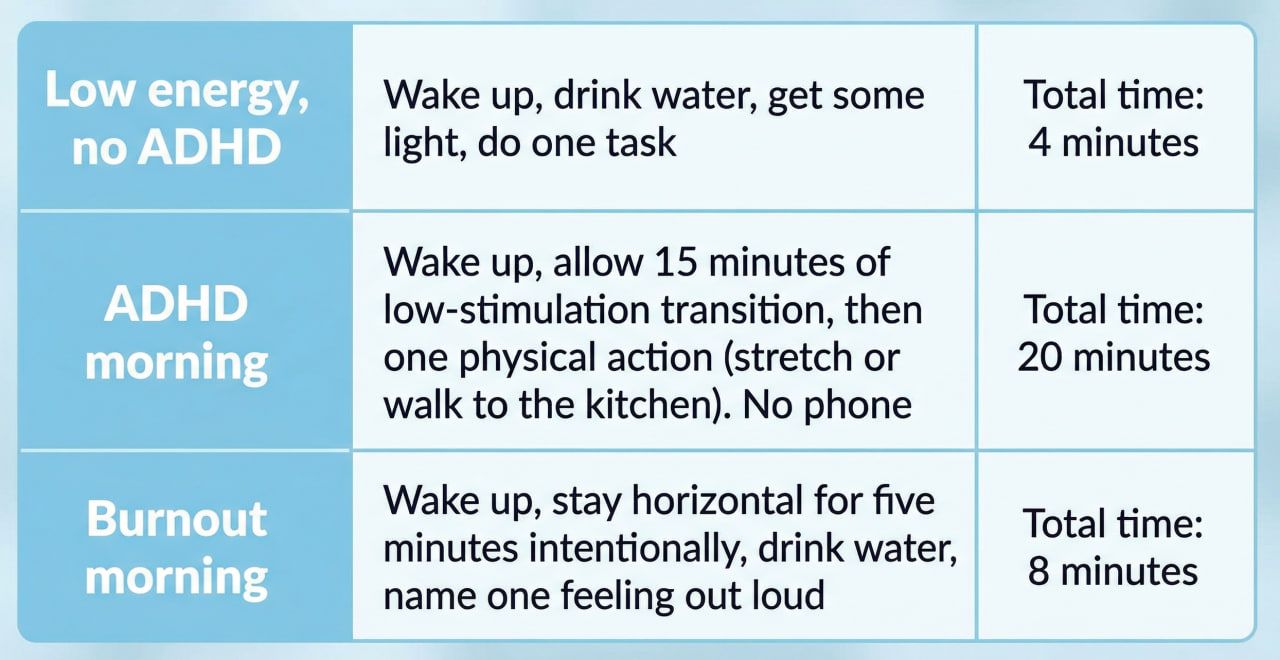
ADHD sleep inertia lasts significantly longer due to a 73 to 78% prevalence of approximately 90-minute circadian delays. This makes early morning routines neurologically challenging. For people with ADHD, a morning routine schedule built around a 7 AM alarm and immediate action is working against the brain's biology. [4]
Low energy and lack of motivation are signs of depression, not flaws in your character. Good morning habits for depression start with one physical anchor, like getting some light or moving around, and then add mental challenges.
To avoid burnout, it's important to cut down on the number of decisions you have to make right away in the morning.
Morning Routine Examples That Don't Involve 5 AM Alarms
Here are three morning routine examples calibrated for different low-energy profiles:
Morning Routine Tips to Reduce Decision Fatigue
Things to Do Early in the Morning to Avoid Overwhelm
Decision fatigue starts earlier than most people expect. Every little choice you make in the morning, like what to wear or eat, comes from a limited energy supply for that day.
A morning routine schedule reduces decision load by converting repeatable choices into automatic sequences.
Morning routine tips for reducing decision fatigue:
- Prepare clothes and bags the night before.
- Eat the same breakfast on low-energy days.
- Use a fixed morning routine list in the same order every day. Sequence removes the need to choose what comes next.
- Limit your morning routine to five steps or fewer. More steps mean more decisions.
- Set your single most important task before bed, so the morning starts with direction already established.
The goal of good morning routines is not to accomplish more before noon, but to arrive at noon with your cognitive reserves intact.
Summary: Redefining What to Do in the Morning
A productive morning routine is one you can also follow on your worst days and still feel functional by the end of it.
The best morning routines for productivity are consistent. They are designed around your real energy, your real neurotype, and your real life. They treat your lowest state as the design constraint.
Start with the bare minimum, and give yourself full credit for every step you take, no matter how small. Attainify will help every step of the way.
Frequently Asked Questions (FAQ)
How long should a good morning routine take?
A good morning routine takes as long as your current energy state supports.
On high-energy days, 30 to 60 minutes of structured morning activities builds momentum. On low-energy days, four to eight minutes of bare minimum actions keep the pattern alive without demanding capacity you do not have.
The length of your morning routine schedule is less important than its consistency across variable conditions.
What if I fail my morning schedule every day?
Failing a morning schedule every day is a signal that the schedule is wrong, not a signal that you are.
Review the routine and ask whether the design reflects your average day or your ideal day. If the design is ideal, redesign for the average. Start with two actions. Add a third only after the first two feel automatic.
Attainify's diagnostic quiz and 30-day adaptation model exist precisely for this situation: to help you build a morning routine functioning as a real system, not a wish list.
Sources:
https://pmc.ncbi.nlm.nih.gov/articles/PMC6250589/
https://pmc.ncbi.nlm.nih.gov/articles/PMC9529170/
https://pmc.ncbi.nlm.nih.gov/articles/PMC12728042/



Related Articles




Ready to Transform Your Life?
Take our 1-minute quiz and start your journey to self-discovery and personal growth today.
1-Minute Quiz